Showing posts with label niesh. Show all posts

29 August 2016

It needs to be repeated: From the very beginning, VA science and policy were 100% WRONG on C-123 Agent Orange

In fact, VA was wrong and was determined to prevent our disability claims as a matter of policy regardless of the science involved. From the very beginning our search for help, VA ignored it's fundamental obligation to us as veterans.

No other veteran or veterans organization, supported in the scientific claims for harmful Agent Orange exposure by the CDC and other federal agencies as well as dozens of independent positions and university based scientists, has faced such an automatic VA opposition.  Today's perspective, 18 months after the release of the Institute of Medicine C-123 Report, clearly shows VA opposition was policy-based. VA simply had no scientific or legal basis to oppose the claims – yet they did.

Rather than permit us the benefit of the doubt required by law and M21-1MR they immediately took an adversarial position. That was most perfectly expressed by Mr. Thomas Murphy (Director, VBA Pension and Compensation) when on February 28 2013 he insisted no amount of proof from whatever source would be accepted by VA to support our claims.

Mr. Murphy explained that Veterans Health Administration Public Health decided upon our first inquiries back in early 2011 that, no matter what, C-123 vets were not exposed and VA would deny every claim. VA would do this while insisting that every claim would be considered on a case-by-case basis... and then automatically denied.

As regards the requirement to give us benefit of the doubt, VA reserved it for itself and denied it to the veterans. Even after support for our exposures was submitted to the VA by the CDC ATSDR as well as the National Institute of Environmental Health Sciences, DoD JSRRC and dozens of independent physicians and researchers VA stuck to its illogical and unscientific as well as blatantly anti-veteran position

Nothing illustrates the deception VA used against us better than the simple comparison of the May 2011 VA position statement (below, formulated by Dr. Terry Walters and her colleagues in VHA Public Health) and the final report on us published by the Institute of Medicine in January 2015.


Let's look at VA's five bullet points:
1) Correct, but irrelevant. The 1991 Agent Orange Act requires VA to treat all veterans exposed to Agent Orange if they have relevant illnesses. VA repeatedly assured Congress and the public via the Federal Register that it would do so.
2) Deceptive. There is only the issue of exposure, not the kind of exposure. For the purpose of opposing our claims, VA introduced the idea of remote/secondary exposure and claimed it made proven contamination of our aircraft no different than the theoretical contamination of the equipment used in Vietnam.
3) Ridiculous! VA stated it would ignore all proof of exposure from whatever source such as the CDC. We did not know it for years but VA had unscientifically redefined the word exposure to require bioavailability for exposure to be recognized. VA created its own unique redefinition of exposure to block our exposure claims, and were criticized for doing so by leaders in other federal health agencies. Even under this redefined exposure, VA should have acknowledged the bioavailability of the C-123 Agent Orange contamination when the CDC informed of them that veterans had a 200 times greater risk of cancer. VA uses Dorland's  Illustrated Medical Dictionary as the standard text of definitions... except for the word exposure.
4) Deceptive. The 1991 Agent Orange Act eliminated the requirement that a veteran establish medical nexus of illnesses associated with Agent Orange and instead provided a presumption. The scientific evidence suggested as missing was already established by the Institute of Medicine and it's numerous earlier reports. Further, as with the first point, VA have a legal obligation as well as the duty under its own regulations to treat all veterans with a proven Agent Orange exposure.
5) The last bullet point is perhaps the VA's most blatant policy driven deception. The opinions referenced as supporting our claims came from the CDC ATSDR, National Institute of Environmental Health Sciences, and dozens of university scientists and independent physicians. Rather than acknowledging this volume of proof, the VA Agent Orange desk in Veterans Benefits Administration simply asserted that it had "an overwhelming preponderance of proof" against our exposures. In fact there was no such proof against our exposure claims and VA insistence otherwise was merely a policy statement. The IOM C-123 Agent Orange Report relied on the same body of evidence to reach an opposite conclusion – veterans were indeed exposed!

VA Conclusions Rigged Uo To Deny Claims For Five Years:
1) "Even though residual Agent Orange may be detected in C-123 aircraft by laboratory techniques years after Agent Orange use, it must be remembered that there is no bio-availability of TCDD in these aircraft. "
2) "The potential for exposure to Agent Orange and TCDD and subsequent development of any adverse health effects from flying in potentially contaminated C-123 aircraft years after the Vietnam War is essentially zero."
Terry J, Walters, MD MPH: Director, Environmental Health, VHA

BUT, the Institute of Medicine concluded after studying the same data:
1)  Veterans suffered bioavailability of the dioxin aboard the aircraft by all three possible routes (dermal, inhalation, and ingestion.) IOM specifically disproved the VA theory of no bioavailability of dried dioxin advanced by VHA Post-Deployment Public Health. That flawed concept was earlier advanced by Dr. Alvin Young who actually argued against any hazards of Agent Orange in his article "Environmental fate of TCDD and Agent orange and Bioavailability To Troops in Vietnam."  A frequent VA and DoD consultant, Young was beneficiary of a no-bid sole source $600,000 consulting contract most of which focused on our aircraft.
2) "Reservists experienced increases in their risks of adverse health outcomes." In fact, the CDC told VA veterans had a 200 fold greater risk of cancer.

27 March 2014

Dr. Linda Birnbaum, Director Nat'l Institute of Environmental Health Sciences Recognized by C-123 Veterans

Members of the C-123 Veterans Association had the opportunity this weekend to recognize Dr. Linda Birnbaum and her staff for the dedication shown over the years by NIEHS and the National Toxicology Program, as they helped meet the needs of military families. Indeed...our profound thanks!

Unfortunately, having met this dynamic leader, I can't imagine there being a space left on her office walls for our plaque, but it certainly felt wonderful to express our appreciation and respect to this lady!

23 March 2014

ATSDR CONFIRMS Dermal Route for C-123 Dioxin Exposure

VA has "explained" to the veterans' community that C-123 flyers were not exposed, and primarily
because, as they put it, "TCDD does not readily cross human skin." This was their summation of Weber's quite dated 1991 article.

So, quoting a 23 year old publication and ignoring more current juried articles with contrary findings firmly supporting C-123 veterans' claims, VA's Post Deployment Health unit concluded C-123 veterans were not exposed. Because the dermal barrier is near-perfect, they told us. Anything to block disability claims.

They're wrong. VA VHA issued a blatant twist of facts. Along with similar conclusions in TG312, here what the CDC/Agency for Toxic Substances and Disease Registry said, confirming our OCCUPATIONAL EXPOSURE resulted in dermal absorption – BIOAVAILABILITY! 
"[T]he ability of the skin to absorb dioxins (bioavailability)is slow except during occupational exposures." (p.5)
Also, the Japanese Environmental Agency:
 "Oral Intake and AbsorptionDioxins are absorbed through the gastro-intestinal tract, skin, and lungs. The degree of absorption varies with the congener, the route of absorption,and the medium."
Thus, even with VA's twisted redefinition of exposure (exposure = contamination field + bioavailability) we have federal agency support for both our exposure and the bioavailability.

There's more. The NIH/National Institutes of Environmental Health Sciences also reported that dermal contact with TCDD results in absorption...dermal exposure:


 1991 Feb;107(2):302-10.

Absorption of 2,3,7,8-tetrachlorodibenzo-p-dioxin (TCDD) after low dose dermal exposure.

Abstract

Human dermal exposure to 2,3,7,8-tetrachlorodibenzo-p-dioxin (TCDD) occurs through contact with soil and paper products

08 March 2014

Recent C-123 IOM Study Project: Views of Others

From others in Federal Government, commenting on the C-123 study project VA issued to the IOM
last month:
"It is important to note that the Federal Government possesses organic scientific resources and expertise that has already concluded these aircraft likely posed a health hazard and the aircrew were likely exposed to dioxin. The introduction and arguable necessity of a non-governmental body to opine to the Federal Government on this topic should raise some questions, if not only because it involves additional time and cost to the taxpayer to execute a contract for a purpose which may be unnecessary and unjustified given the scientific facts already known and the Federal statute already in force."

Already having issued findings supporting C-123 exposure claims are the CDC/ATSDR, NIH/NIESH, US Public Health Service, and numerous physicians and scientists outside the government.

04 March 2014

VA's National Center for Ethics in Health Care

Beginning in January, C-123 veterans brought a series of ethical concerns to the VA National Center for Ethics in Health Care. We had both intrinsic and extrinsic ethical concerns on a wide variety of VA actions.
We have been told the Center is not able to assist in our ethical questions. Although our confidential inquiries were elevated to the Center's chief, we were referred to the VA IG or perhaps US Attorney for any further discussions. It is disappointing to have a number of ethical concerns and not find understanding and resolution from the Center charged with that responsibility. We sought help understanding where we might be in error or have inadequate perceptions of situations. But as they suggested, many of the issues do seem to surpass "mere" ethical concerns.

As veterans, we are invited to turn to the Center for such a consult. This was very important because while we could describe the facts surrounding situations we were unskilled in correctly relating them to the highly sensitive area of ethical concerns...and wanted to insure that our situation, expressed with
caution and supporting materials, was received with the Center for help making a determination as to the ethical implications and search for a resolution with concern for avoiding any inferences of individual wrong-doing. Turning to the Center, however, turned out not to be the solution.

Among the many concerns about VA were raised:
• Selective use of references to achieve pre-determined conclusions against veterans' fundamental claims
• Improper reference to selective literature review as "all available scientific information which instead dismissed literature not contributing to predetermined conclusion
Questionable scientific methods
• Failure to obey the laws, and regulations, concerning veterans proving exposure to military herbicides being entitled to seek VA service-connection for recognized illnesses
• Failure to seek peer review, and failure to respond when independently offered by leading experts
• Failure to react to veterans' claims in a pro-veteran perspective
• Misstatements by senior leadership to veterans' legislators denying blanket policy of denying all Agent Orange C-123 claims
• Redefinition of "exposure" for policy objectives, without peer review or regulatory authority, and failure to respond to peer input contesting the redefinition, to circumvent the laws and regulations requiring VA to recognized exposed veterans' claims for Agent Orange-associated illnesses
• Official findings by other federal agencies confirming veterans' claims being mischaracterized into failure to support the claims
• Providing "boilerplate" claims denial language to regional offices, with questionable rejection reasons such as "regulations prohibit recognizing C-123 exposure claims" (there being no such regulation)
• Overriding regional office recommendation for claim approval, directing all claim be denied (but telling the Senate each claim is evaluated on its own evidence)
• Denying claims citing "a thorough search for supporting evidence failed to substantiate" but ignoring all submitted references of valid scientific and medical input since 2011
• Failure to accept input from NIH/National Institute of Environmental Health Science finding confirming C-123 veterans' exposure claim, the NIESH having statutory authority in this area
• Failure to accept input from US Public Health Service confirming C-123 veterans' claims, the USPHS having scientific and medical expertise in this area
• Failure to properly characterize expert toxicologists' scientific input confirming veterans' exposure, instead dismissing input as from scientists unqualified to comment on medical nexus; rejecting all toxicological input in violation of both 8th and 9th US Circuit Court decisions
• Unscientific dismissal of federal agency confirmation of C-123 exposure, inserting manipulative and deceptive sentence implied to be part of that agency's finding, that  no "conclusive evidence exists of TCDD exposure implications." Additional failure to correct when deception was repeatedly brought to the attention of senior personnel in Veteran Health Administration. Veterans Benefits Administration, and General Counsel.
• Failure to honor obligations specified in Federal Register 31 August 2010, with VA determined to prevent veterans' exposure claims; general failure to assist
• Deceptive Internet pages, some stating the inclusion of C-123 veterans with proof of exposure as able to submit claims, but Catch-22 hyperlinks to other pages asserting these veterans disqualification by predetermined rulings from Post Deployment Health
VA War Related Illness and Injury Study Center, which offers exposure assessments, has on its Internet site the VA's explanation as to how our exposures never occurred, despite all evidence to the contrary from other federal agencies and scientists (none of which is cited in "The science behind their conclusion"...which was instead a mere very selective review focused solely on C-123 exposures and designed for prevention of such claims, regardless of the law:
• Failure to reveal large potential savings by denying C-123 veterans exposure benefits
• Failure to resolve confusion regarding veterans' access to Agent Orange Registry, with the Secretary earlier issuing a directive that all veterans believing themselves exposed can receive an exam, but Post Deployment Health overruling the Secretary and forbidding C-123 veterans those exams, without clarification on the Internet page for the Registry
• Highly questionable use of Agent Orange Committee of the Institute of Medicine. The 2012 promise by VA to contract with IOM for a study was broken, but raised again two years later with a forecasted two year delay in any results from the study. Improper to scheme to use IOM as a delaying tactic faced with recent significant legal and scientific evidence surfacing which confirms C-123 veterans' claims. Ample proof exists today to meet the fundamental qualification under the law...these C-123 veterans were exposed to military herbicides – no moral or legal excuse for denying medical care to these veterans. VA seeks to postpone providing expensive medical care to ill and elderly veterans – the longer the delay, the greater the savings by refusing all care and benefits (dental, prosthetics, vision, pharmacy, rehab, primary care, counseling, etc.)
• Questionable influence upon the Joint Services Records Research Center to obstruct collection of documentation confirming veterans' exposure claims
• Questionable influence upon DOD/DCS/Logistics & Mission Support preventing designation of Agent Orange Exposure Sites


This is the VA motto...Defining Excellence in the 21st Century. In medical care...yes, most certainly. But if this is how VA expects to define Department-wide excellence...with deception of our legislators, mistreatment, broken promises, delayed medical treatment, unjustified dismissal of valid claims, use of consultants hostile to veterans issues, and other failures, VA has indeed redefined "excellence" with the same scientific precision as in their unique redefinition of "exposure!"

There is no shortage of medical and scientific excellence – once a veteran gets past the VA hospital doors, guarded so carefully by Post Deployment Health The care is loving, skillful, and life-saving...we want it for all our C-123 veterans!

The only excellence evidenced outside those doors is in the recognized skill of C&P and PHD in obstructing valid veterans' exposure claims.

Where can we turn? We've sought help from our VA doctors, Patient Affairs, General Counsel, VA Ethics Center, senior VA executives, the press, other veterans' organizations, expert scientists and physicians...but nothing will permit a C-123 veteran's claim for exposure to military herbicide to be approved. So, the only excellence we're able to acknowledge is that of Post Deployment Health.

They were charged with preventing our claims and they have succeeded perfectly. 100% of the VARO claims have been denied, and, other than spreading unscientific and misleading information with the hope it will help prevent claims, PDH has only an indirect role with the BVA. This small staff took on all of science and medicine by redefining exposure just for their own use. This small staff took on multiple federal agencies confirming the C-123 veterans' exposure and dismissed them all. This small staff successfully stalled all C-123 veterans' claims for the last three years, and with their suggestion for another IOM study, skillfully employed another stall good for two and perhaps, even three more years of denying all care and benefits to these aircrews.

03 March 2014

DOCUMENTED: VA Maneuvers to Deny C-123 Veterans' Exposure Claims

VA's Post Deployment Health (PDH) has informed VA's Compensation and Pension (C&P) that C-123 veterans' claims for exposure to military herbicide are to be denied. This was confirmed through the Director of C&P as well as through the now-Acting Director PHD.

That official also told a Senate staffer, words to the effect that "VA just couldn't permit any more veterans" with new AO claims of exposure to be granted disability. And certainly, VA has followed through, denying every C-123 veteran's claim at their regional offices, with those offices even provided boiler-plate language to simplify the process. 

VA denies all these claims, but also tells the veterans' legislators that no such blanket policy preventing claims exists. VA prevents JSRRC from responding with solid confirmation of veterans' claims, and prevents DOD from acknowledging the C-123s (now destroyed as toxic waste) as Agent Orange Exposure Sites.

Of course, the process followed by VA is illegal. The law provides veterans benefits to veterans proving exposure to military herbicides, as C-123 veterans have done. VA takes the position that these veterans must satisfy an additional burden beyond that in the law...C-123 vets must prove bioavailability to meet the VA's new redefinition of exposure.

In this post, we examine the treatment of an advisory opinion issued by C&P, following a regional office's inquiry about a C-123 veteran's claim they wanted to approve. C&P directed the claim be denied. Let's look at their letter back to the RO and see the deceit.

It is the heart of the deception, revealing VA's bold determination to bar C-123 claims:
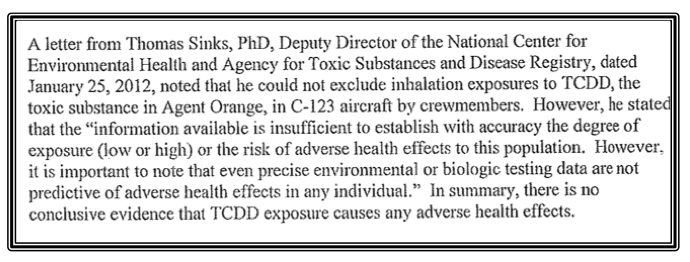
(Text from Compensation & Pension Advisory Opinion, summarizing CDC/Agency for Toxic Substances & Disease Registry, which actually CONFIRMED  veterans' TCDD exposure.)
Dr. Sinks is the respected Deputy Director of the CDC/Agency for Toxic Substances and Disease Registry. That agency has the statutory responsibility, and scientific expertise, to provide expert findings in such situations but VA dismissed the agency's official finding. Note the last sentence: "no conclusive evidence that TCDD causes adverse health effects." Here, C&P is denying this veteran's claim with the assertion that TCDD (the toxin in Agent Orange) is harmless.

This last sentence was inserted as though it was part of the ATSDR conclusion...it absolutely was not. Dr. Sinks said no such thing – ATSDR determined exactly the opposite – veterans were indeed exposed! But VA opted to deceive in their zeal to keep VA hospital doors locked to C-123 veterans.

And the VA did even more: Dr. Sinks' report to the VA found that C-123 veterans had a 200-fold greater risk of cancer and their exposures aboard their aircraft were 180 times Army standard values. Most importantly, Dr. Sinks reported "I believe aircrews operating in this, and similar, environments were exposed to TCDD."

We do not see these, the most important parts of Dr. Sinks' official report on behalf of the CDC/Agency for Toxic Substances and Disease Registry, in the C&P summation. Not only did the VA deliberately twist the ATSDR's finding that vets were exposed into a denial of the harm of TCDD, but VA deliberately avoided mention of the extremely persuasive parts of the ATSDR report.

What should one conclude? That VA was bent on preventing the C-123 claims. That VA was so committed to preventing these claims that VA would deliberately mischaracterize an official finding by another federal government agency. And deliberately avoid mention of any affirming statements such as were submitted by Dr. Sinks. Everything confirming the veteran's claim was ignored.

The Sinks finding was subsequently reaffirmed by the Director of ATSDR, Dr. C. Portier, and then later by the Acting Director, Rear Admiral R. Ikeda, MD US Public Health Service. Those supporting documents have been ignored by VA, and VA has also ignored the official finding of other federal agencies, including FDA, US Public Health Service, and the National Toxicology Program. Further, the physicians who submitting opinions confirming the veteran's exposure were simply ignored, including the VA oncologist treating the veteran and who is an acknowledged Agent Orange researcher.

VA is by law required to be veteran-friendly, non-adversarial, and review and weigh veterans claims materials "sympathetically." Here, VA did not comply with any of these requirements. Further, in this Advisory Opinion, VA refused to recognize expert opinions supporting the veteran's Agent Orange exposure claim from a number of recognized Agent Orange scientists, stating that these scientists were not qualified to comment on medical nexus. Scientists from Oregon Health Sciences University, Columbia University, Boston University were dismissed.

But the scientists addressed the requirement in the law for proving exposure...their comments had nothing to do with medical nexus which is not something veterans need to prove – it is presumed for veterans with proof of exposure. Clearly, here the VA report was an unmistakable prevarication...a deception using true words to deceive.

And C&P succeeded – the claim was denied. Of course the veteran can appeal, and the current wait time is over 900 days. On top of the three years since the claim was filed, that's six years of locked VA doors. Hopefully, some veterans will survive this process, but Compensation and Pension isn't doing anything to speed up things...the fewer veterans surviving the claims process, the greater the savings.

We're not making this up. Print out the CDC/Agency for Toxic Substances and Disease Registry report on the C-123 veteran, and print out the Compensation and Pension Advisory Opinion ordering the claim denied. Compare, and also be aware that the veteran submitted over 100 other documents from physicians, scientists, universities, research reports and other federal agencies supporting his claim...remember, too, the regional office recommended approval, but was overturned by C&P.

I have to ask...the VA's heavy-handed slam-down is obvious. And obviously unlawful. VA knows it. The Senate knows it. The veterans and their service organizations know it. Why isn't anything done?

Because the VA is responsible for administering the Nation's veterans laws, VA decides which to obey and which to ignore. If a few staffers in an office get a perspective that they don't want to do something, it doesn't get done. In this case, a few folks in VA's Post Deployment Health section decided to redefine exposure to prevent C-123 claims, and directed C&P to make certain all such claims are denied.


If a veteran were to have attempted such deceptions as done by the VA, VA would prosecute for attempted fraud. 


Here is the ATSDR finding confirming C-123 veterans' Agent Orange exposures:
Here is the Advisory Opinion from C&P, dismissing all expert input and denying the claim by deceitful, unethical and perhaps illegal manipulation of the ATSDR opinion 

27 February 2014

VA Uses IOM For New Delays in C-123 Claims

Thanks to the VFW, some clarification has come from VA's Compensation and Pension regarding their position blocking all C-123 exposure claims. VFW reports that C&P stated:


"We consider claims as received and will consider any and all medical and/or scientific evidence provided.  If evidence provided and/or obtained results in a determination that there is reasonable doubt as to the cause of an exposure, the claim will be granted. 

We have asked the Institute of Medicine to look at the potential for harmful exposure to Agent Orange in C-123s that were used to spray the chemical in Vietnam.  We expect their report to be released in the first quarter of FY 15.  VA will review it and brief the Secretary on any findings and recommendations." 

In the meantime, we will consider claims on a case by case basis.”

I wonder why this was a month ago, with no involvement of the affected veterans?

Problem: VA Compensation and Pension, and VA Post Deployment Health (which issues the project to the IOM), have already ruled that no "reasonable doubt" will be permitted to exist. They already told us they'd decided no C-123 veterans were exposed, and therefore no claims will be honored. Putting a fine point on it, Dr. Peterson actually said "probably not" when asked if any C-123 claims could ever be approved.

And Compensation and Pension already told us that no amount of evidence from whatever source would be permitted to move a claim to reasonable doubt or "as likely to as not" because absolutely no doubt exists (per policy) in their minds.

There is no doubt in our minds, either. We were exposed. So says the CDC/ATSDR, the NIH/National Toxicology Program, the US Public Health Service and many others. The law clearly states exposed veterans will be treated for Agent Orange-type illnesses, as reaffirmed by the VA itself in the Federal Register of 31 August 2010. Exposure is the key, and exposure is what VA has fought. And lost.

Now, thanks to an excellent juried article published in the Journal of Environmental Research, exposure to military herbicides is in no doubt. VA's highly selective choice of references in their "thorough" review of scientific literature won't hold up to a juried article by distinguished experts, especially with the weight of the other findings and opinions.

So...VA, seeing the ground disappear from beneath their platform of exposure denial, now proposes to change tactics. They'll call for a two to three year time out by NOW turning to the Institute of Medicine.

Readers will recall our enthusiasm back in early 2012 when we met with VA's Post Deployment Health in a conference hosted by Senator Burr's staff. The VA explained that they would not yield on considering our claims for Agent Orange exposure. But at the end of our discussion VA promised us as a compromise a special review through the Institute of Medicine. That promise was broken, then finally ordered in March 2014.

In May 2012, the Air Force released its now-tainted UC-123 Consultative Report which didn't agree with veterans' claims, nor with other government agencies which had opined that the C-123 crews were exposed. The VA, without discussion with the veterans to whom they'd made their promise, promptly broke their promise and cancelled the IOM study.

Ever since, VA raters have continued denying claims by citing non-existent regulations prohibiting recognizing our exposure, or saying a thorough search through military records fails to show evidence of exposure, or TCDD is harmless...a variety of Compensation & Pension-provided boiler plate denials.

VA slams us with one of two, or perhaps both, harmful results. One is that the IOM project will float back to VA in 2015, and perhaps a reaction from the Secretary a year or so later.  Great, says VA, because at least they avoid covering expensive medical care for Agent Orange-exposed veterans for another two or three years...on top of the years we've already waited. On top of the two years since their last broken promise...now they suggest we wait a few more years. Back in 2012, Dr. Dick said it would only take six months...but now VA certainly hopes to stretch that out as far as possible...the longer the wait, the greater the savings for VA.

The second possible result is that IOM disagrees with the medical impact of the C-123 exposures. VA would then deny all claims and insist that BVA also deny appeals. VA hopes for both results.

But (we pray) an IOM decision is unlikely to go against the C-123 veterans. Exposure and medical impact are already evidenced. No medical tests could prove bioavailability today, given the half-life of dioxin in the human body is seven years and it has been 32 years since the veterans' last exposure, and 42 since the veterans' earliest exposures.

But lets say the IOM fails to support the veterans' assertions. VA is still faced with the obligation to treat all veterans exposed to military herbicides. Does Compensation & Pension expect VA to turn to Congress and ask for new legislation to prohibit Agent Orange claims from C-123 claimants?

This won't wash! Two years ago, we fell for it and accepted with good graces VA's promise to seek an opinion from IOM. They broke that promise. Now that we have even more proof, even clearer legal foundations, even stronger support, VA is telling us they've discovered a new way to delay.

Delay, delay, delay until we die. The more of us who die off, the greater the VA savings.

We have to ask our legislative representatives and veterans' organizations not to let this happen. Our claims are fully justified today, and it is immoral and illegal to block our access to VA medical care for more years.

If the USAF had made known our exposures when they were first identified in 1994, those of us with Agent Orange-presumptive illnesses could have sought care then and since. Instead, all contamination information was "kept in official channels only" per order of the USAF Office of Environmental Law.

We began uncovering the C-123 contamination story in early 2011 and faced the immediate, automatic, mindless VA denial. Post Deployment Health had the responsibility to look into this in a pro-veteran manner, but instead stooped to redefinition of exposure to prevent acknowledgement of our proven exposures.

They denied perfectly valid claims stating TCDD is harmless. They ignored official confirmations of our exposure submitted by the ATSDR, ignored and tried to hide findings that crews were exposed and that our cancer risks were 200-fold greater, and completely mischaracterized the ATSDR conclusion by 180 degrees. They ignored the finding submitted in our support by the CDC/NIESH. They manipulated responses from the JSRRC. And I believe the Secretary isn't fully informed about any of this.

Compensation and Pension knows exactly what they are doing. They are skillful and dedicated. Dedicated to preventing our claims because of their personal preferences to block us.

Compensation and Pension knows exactly what they are doing. At our average age of 65, with even a regular life expectancy of seven years remaining, VA now suggests their scheme to consume 40 to 60% of our remaining life expectancy waiting to see what the Secretary will do.

Compensation and Pension knows exactly what they are doing. At our ages, with (from the webmaster's situation) heart disease, diabetes, peripheral neuropathy, avascular necrosis, spinal cord injury and prostate cancer...they propose that a guy like me wait more years to see if the VA will try to save my life?

Immoral, Unethical. Illegal. Unscientific. How dare they scheme to lock VA hospital doors for another two or three years?


22 February 2014

VA Definition of “EXPOSED” – Another Scientist Challenges VA

VA: “Exposure = contamination field + bioavailability.” 

The term exposure was redefined (from the VA perspective, not by regulatory authorities or industrial standards nor any other peer-reviewed action) to include bioavailability,VA's objective being evasion of requirements in the law for providing exposure care to C-123 veterans. The flyers’ exposures were redefined away with VA’s novel redefinition of exposure. No bioavailability = no exposure =denied claim.

The VA redefinition of exposure was apparently first utilized at the VA’s poster display for Society of Toxicology 2012, where the line appeared as part of the historical perspective of Agent Orange, the focus of the poster. It was an official VA poster, with none of the usual disclaimers about not necessarily reflecting agency typical…indeed, usually recommended, on such scientific displays. After SOT 2012, VA continues to deny veterans’ claims insisting the veterans failed to prove bioavailability.

In fact, the bioavailability requirement was grasped by VA’s Post Deployment Health and included by them in the VA’s poster, Agent Orange: 50 Years of History which staff of Post Deployment Health presented themselves. The VA need for a creative redefinition of exposure became apparent when the Federal Register of 31 August 2010 carried a VA statement that the Department would provide “presumptive service connection” to non-Vietnam War veterans able to prove their exposure to Agent Orange. 

Post Deployment Health was faced with either treating the exposed veterans, which policy opposed, plus yet another significant impact on the Department’s health care budget...or VA could create some ways preventing C-123 exposure from being acknowledged.

Thus was born the VA redefinition of a fundamental toxicological term. The VA redefinition is unique, not used elsewhere in science, medicine or government. VA has no statutory or regulatory authority to define such terms. The agencies which do have such authority include the CDC/Agency for Toxic Substances and Disease Registry, and the National Institutes of Health/National Toxicology Program. Both agencies have taken exception to the VA’s redefinition.

In particular, objections were voiced by Dr. Linda Birnbaum, Director of the National Toxicology Program. She wrote,” In all my years as a toxicologist, I have never heard bioavailability as part of the exposure field. Exposure is skin contact (or inhalation or ingestion) with a chemical of any type.”

courtesy of Professor. R.S. Pollenz, Univ. South Florida

Bioavailability itself MUST follow exposure , but not all exposures have the subsequent event of bioavailability. Further, bioavailability is a complex concept based on the chemical nature of the agent.  There is also the major concept of biotransformation since nearly all compounds are metabolized once they enter the body.  TCDD and PCBs however, are somewhat resistant to the biotransformation, since humans do not have enzymes that are able to remove the CL molecules (this is one reason why CL is used as a halogenating agent in creating T45T and other chemicals that kill stuff).  

Readers may be able to find similar schematics on line and in some of the toxicology text books.  Note that the connections may not be linear and are different for each chemical, but this gives the various terms to keep in mind and the complexity of the process.  If there has been an adoption of any term PRIOR to exposure, or definition of exposure to include another subsequent toxicological event as a required component, this is not correct because one MUST be exposed before anything can happen.  


Perhaps, VA has been focusing on the bioaccumulation from a standpoint of whether the amount that someone may carry is BIOAVAILBLE to do anything.  This has always been a hot area regarding the risk assessment of these halogenated compounds.