03 March 2014

DOCUMENTED: VA Maneuvers to Deny C-123 Veterans' Exposure Claims

VA's Post Deployment Health (PDH) has informed VA's Compensation and Pension (C&P) that C-123 veterans' claims for exposure to military herbicide are to be denied. This was confirmed through the Director of C&P as well as through the now-Acting Director PHD.

That official also told a Senate staffer, words to the effect that "VA just couldn't permit any more veterans" with new AO claims of exposure to be granted disability. And certainly, VA has followed through, denying every C-123 veteran's claim at their regional offices, with those offices even provided boiler-plate language to simplify the process. 

VA denies all these claims, but also tells the veterans' legislators that no such blanket policy preventing claims exists. VA prevents JSRRC from responding with solid confirmation of veterans' claims, and prevents DOD from acknowledging the C-123s (now destroyed as toxic waste) as Agent Orange Exposure Sites.

Of course, the process followed by VA is illegal. The law provides veterans benefits to veterans proving exposure to military herbicides, as C-123 veterans have done. VA takes the position that these veterans must satisfy an additional burden beyond that in the law...C-123 vets must prove bioavailability to meet the VA's new redefinition of exposure.

In this post, we examine the treatment of an advisory opinion issued by C&P, following a regional office's inquiry about a C-123 veteran's claim they wanted to approve. C&P directed the claim be denied. Let's look at their letter back to the RO and see the deceit.

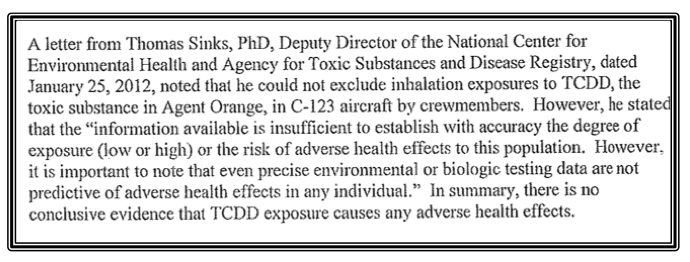
It is the heart of the deception, revealing VA's bold determination to bar C-123 claims:
(Text from Compensation & Pension Advisory Opinion, summarizing CDC/Agency for Toxic Substances & Disease Registry, which actually CONFIRMED  veterans' TCDD exposure.)
Dr. Sinks is the respected Deputy Director of the CDC/Agency for Toxic Substances and Disease Registry. That agency has the statutory responsibility, and scientific expertise, to provide expert findings in such situations but VA dismissed the agency's official finding. Note the last sentence: "no conclusive evidence that TCDD causes adverse health effects." Here, C&P is denying this veteran's claim with the assertion that TCDD (the toxin in Agent Orange) is harmless.

This last sentence was inserted as though it was part of the ATSDR conclusion...it absolutely was not. Dr. Sinks said no such thing – ATSDR determined exactly the opposite – veterans were indeed exposed! But VA opted to deceive in their zeal to keep VA hospital doors locked to C-123 veterans.

And the VA did even more: Dr. Sinks' report to the VA found that C-123 veterans had a 200-fold greater risk of cancer and their exposures aboard their aircraft were 180 times Army standard values. Most importantly, Dr. Sinks reported "I believe aircrews operating in this, and similar, environments were exposed to TCDD."

We do not see these, the most important parts of Dr. Sinks' official report on behalf of the CDC/Agency for Toxic Substances and Disease Registry, in the C&P summation. Not only did the VA deliberately twist the ATSDR's finding that vets were exposed into a denial of the harm of TCDD, but VA deliberately avoided mention of the extremely persuasive parts of the ATSDR report.

What should one conclude? That VA was bent on preventing the C-123 claims. That VA was so committed to preventing these claims that VA would deliberately mischaracterize an official finding by another federal government agency. And deliberately avoid mention of any affirming statements such as were submitted by Dr. Sinks. Everything confirming the veteran's claim was ignored.

The Sinks finding was subsequently reaffirmed by the Director of ATSDR, Dr. C. Portier, and then later by the Acting Director, Rear Admiral R. Ikeda, MD US Public Health Service. Those supporting documents have been ignored by VA, and VA has also ignored the official finding of other federal agencies, including FDA, US Public Health Service, and the National Toxicology Program. Further, the physicians who submitting opinions confirming the veteran's exposure were simply ignored, including the VA oncologist treating the veteran and who is an acknowledged Agent Orange researcher.

VA is by law required to be veteran-friendly, non-adversarial, and review and weigh veterans claims materials "sympathetically." Here, VA did not comply with any of these requirements. Further, in this Advisory Opinion, VA refused to recognize expert opinions supporting the veteran's Agent Orange exposure claim from a number of recognized Agent Orange scientists, stating that these scientists were not qualified to comment on medical nexus. Scientists from Oregon Health Sciences University, Columbia University, Boston University were dismissed.

But the scientists addressed the requirement in the law for proving exposure...their comments had nothing to do with medical nexus which is not something veterans need to prove – it is presumed for veterans with proof of exposure. Clearly, here the VA report was an unmistakable prevarication...a deception using true words to deceive.

And C&P succeeded – the claim was denied. Of course the veteran can appeal, and the current wait time is over 900 days. On top of the three years since the claim was filed, that's six years of locked VA doors. Hopefully, some veterans will survive this process, but Compensation and Pension isn't doing anything to speed up things...the fewer veterans surviving the claims process, the greater the savings.

We're not making this up. Print out the CDC/Agency for Toxic Substances and Disease Registry report on the C-123 veteran, and print out the Compensation and Pension Advisory Opinion ordering the claim denied. Compare, and also be aware that the veteran submitted over 100 other documents from physicians, scientists, universities, research reports and other federal agencies supporting his claim...remember, too, the regional office recommended approval, but was overturned by C&P.

I have to ask...the VA's heavy-handed slam-down is obvious. And obviously unlawful. VA knows it. The Senate knows it. The veterans and their service organizations know it. Why isn't anything done?

Because the VA is responsible for administering the Nation's veterans laws, VA decides which to obey and which to ignore. If a few staffers in an office get a perspective that they don't want to do something, it doesn't get done. In this case, a few folks in VA's Post Deployment Health section decided to redefine exposure to prevent C-123 claims, and directed C&P to make certain all such claims are denied.


If a veteran were to have attempted such deceptions as done by the VA, VA would prosecute for attempted fraud. 


Here is the ATSDR finding confirming C-123 veterans' Agent Orange exposures:
Here is the Advisory Opinion from C&P, dismissing all expert input and denying the claim by deceitful, unethical and perhaps illegal manipulation of the ATSDR opinion 

VA Definition of "Exposure" Unique, Created to Prevent C-123 Veterans' Agent Orange Claims

C-123 veterans are accustomed to resistance from VA in permitting our disability claims based on exposure to Agent Orange (or military herbicides, as the terms are frequently interchanged.)

To better form a basis for preventing C-123 claims, VA staff presented a poster about Agent Orange at the 2012 Society of Toxicology conference in San Francisco, and sneaked in a little line:
"exposure = contamination field + bioavailability."

This meant that VA would recognize veterans' claims for exposure only if there was also proof of some medical implication. No bioavailability equals no exposure, via the newspeak VA definition.

This redefinition is quite unique. It was implemented in the VA without peer review nor regulatory notice, by the staff of Post Deployment Health. The new definition is so unique it isn't found anywhere else in science or medicine, not even elsewhere in VA. Just...for denying C-123 veterans' claims.

Denying a veteran's claim is a big, big deal. Especially to the veteran of course, but to VA as well. It means one more claim off the desk of rating officials, but more importantly, it means lots of money saved! It costs a lot of money to try to keep alive a sick, elderly veteran with toxic exposures plus normal ailments of aging. Cancers, heart disease, hypertension, ALS, etc...better to prevent any access to care than to permit it, especially if the prevention can be as easy as redefining a word like exposure.

Why pick exposure to redefine? Because the VA acknowledged as recently as the 31 Aug 2010 Federal Register that it would treat veterans exposed to military herbicides the same as it treats Vietnam veterans. So "exposure" was an easy target...redefine away the veterans' exposure events and then deny the claims.

The worst that could happen to the VA with this verbal deception is the veteran appeals and three to four years later, if the sick veteran still survives, his claim can be corrected then but that still means years of savings by locking the hospital doors to them, and of course, the hope that the vet will die and the problem go away.

Now, nobody says any particular  VA staffer wants any particular, nice old veteran guy or gal to die. Not something so specific, but in general, yes. The VA view is the fewer pigs (that's us) at the trough (that's the VA) the better. Kept from applying, denied in their claims, or died off before any decision...works just fine for Post Deployment Health.

Judge for yourself the deception of VA in redefining exposure. Note also the DOD definition of exposure...and we were under DOD regs when we flew and became exposed. Neat...DOD says we were exposed but VA says, not on their watch! 

Besides DOD saying we were exposed, ATSDR, NIESH, National Toxicology Program, Boston University, Columbia University, Oregon Health Sciences University, University of Texas Medical School, EPA, US Public Health Service all say we were exposed...but no, Post Deployment Health whips out their redefinition of exposure and tells the guards to get those hospital doors locked...C-123 veterans aren't going to be allowed in!

 Definitions of Exposure Used By Different Authorities:

VA Post Deployment Health: Exposure = contamination field + bioavailability

Society of Toxicology:  In health matters, measurement of levels at which one encounters any substance

Defense Technical Information Center: Intensity, frequency and length of time personnel are subjected to a hazard.

EPA: Contact made between a chemical, physical, or biological agent and the outer boundary of an organism.

EPA (pesticides): Radiation or pollutants that come into contact with the body and present a potential health threat.

American Chemical Council: Occurs when an employee is subjected to a hazardous chemical in the course of employment through any route of entry (inhalation, ingestion, skin contact or absorption, injection), and includes potential (e.g., accidental or possible) exposure.

Lawrence Berkeley National Labs: contact with a toxic substance

US National Medical Library: Process by which a substance becomes available for absorption by the target population, organism, organ, tissue or cell, by any route.

ATSDR: Contact with a substance by swallowing, breathing, or touching the skin or eyes

EPA: contact between an agent and the visible exterior of a person

Web Taxonomy: Contact between a chemical and the skin

Johns Hopkins School of Public Health: Any condition which provides an opportunity for an external environmental agent to enter the body

The Law Dictionary: Contact or exposure to a chemical substance by touching, breathing, eating or drinking. 

Journal of Exposure Science and Environmental Epidemiology: event when a person comes into contact with a toxic material.

IPCC: nature and degree to which a system is exposed to significant variations

WHO, & IPCS: Contact between an agent and a target – Exposure does not automatically lead to an internal dose

OSHA: skin, eye, mucous membrane, or parenteral contact with potentially harmful materials that may result from the performance of an employee's duties 

OSHA (disease process, such as TB): in the presence of exhaled breath of infected individuals or in the presence of such individuals in situations where procedures are performed with any potential to develop airborne droplet nuclei.

California Environmental Health Hazard Assessment: transport of chemicals from a source to an individual or population

California EPA: contact by an individual or population with hazards through radiation, inhalation, ingestion or direct skin contact. Contact that does not involve transport of the hazard through an environmental medium is also possible, as when a child ingests chemicals used as plasticizers in pacifiers or lead in paint chips. The duration and frequency of exposures to harmful agents influence adverse outcomes. Exposure may be continuous; discontinuous but regular (e.g., once daily); or intermittent (less than daily, with no standardized, quantitative definition). The magnitude of exposure or dose determines how much of a hazard can be taken up by an individual or population, i.e. bioavailability.

Definition of Bioavailability: degree to which a material in environmental media can be assimilated by an organism, or: The ability of a substance to affect organism.

C-123 Veterans Refused Agent Orange Registry Exam

As in 2013, we continue getting inquiries from our C-123 veterans trying to sign up for the VA's Agent Orange Registry Exam, but being refused by the VAROs. We even have VAROs such as Portland saying exams are available to C-123 veterans yet others, such as in Florida, refusing per the firm instructions from Post Deployment Health. Also confusing the situation is an earlier order by the Secretary of Veterans Affairs that any veteran claiming exposure be invited to the Registry.

The reversal of the Secretary's directive, per order of Post Deployment Health, is unfortunate and we don't agree, but it is correct.  VA's Post Deployment Health Acting Chief Consultant, Dr. Terry Walters, was asked by us last year about the language on the VA's exposure page inviting all veterans who believe they've had an exposure event to call the Registry.

Apparently the only way to regain permission to have an Agent Orange Registry exam is to petition the Secretary to reinstate his order following Post Deployment Health canceling it.

Too many of the C-123 veterans were relying on proofs of their dermal, inhalation or ingestion exposures to TCDD aboard the C-123 to conclude they'd been exposed. They were not aware of the VA redefinition in 2012 of "exposure" to redefine their TCDD exposures in a manner providing VA a way to deny exposure events. Yes, the vets were exposed in a scientific or medical sense, but no, not exposed per the VA's own unique redefinition created by Post Deployment Health for preventing claims.

The new definition used by VA for exposure requires veterans to proof that somehow that the TCDD we'd been exposed to had a biological effect...our exposures don't exist unless we can prove medical effect. This is hard, of course, with the VA prohibiting exactly those tests, plus we know the half life of dioxin in the body is 7 to 8.5 years, and for many of us it has been over 40 years since exposure.

VA has asked for a proof they know is impossible to provide, which is, of course, the purpose of their redefinition of exposure. (exposure = contamination field + bioavailability.)

Proceeding from that special, but unscientific redefinition of exposure, and strengthening the barrier against C-123 claims, Dr. Walters changed the qualification for requesting an Agent Orange Registry exam to restrict it to only those veterans who'd been in the presence of liquid Agent Orange, as below. Thus, handling or being in any way exposed to Agent Orange in a solid or dried or vaporous form does not qualify for "exposed" per Dr. Walter's new restrictions.

On May 13, 2013, Dr. Walters kindly clarified her change in her email to me, although Post Deployment Health hasn't yet spelled out on the VA page for some reason:
"Other potential Agent Orange exposures:
Veterans who may have been exposed to herbicides during a military operation or as a result of testing, transporting, or spraying herbicides for military purposes. Learn about herbicide tests and storage outside Vietnam. Agent Orange or Dioxin dried on surfaces does not present a significant threat to human health. Veterans are eligible if they were in the presence of liquid Agent Orange such as when Agent Orange was sprayed, tested or transported."

As we suggested last year, we again ask Dr. Walters to more clearly implement her changes on the VA web site to prevent confusion. Too many of us go by VA regulations or statute, and obviously these conflict with internal VA staff personal preferences for management and prevention of exposure claims. The VA page was updated in December 2013 but lacks the changes implemented by Dr. Walters.

02 March 2014

Comments? From Staff of Post Deployment Health or Compensation and Pension?

You know what's wrong...set it right!
You VA staffers doing the grunt work...you see what's going on. You sat around the table when we had our meetings and heard the positions from us and from the VA. You've seen the in-house communications at the attitude VA has about these veterans. You've seen the orders to deny C-123 claims with boilerplate language provided by C&P.

You know how that contrasts with assurances by both General Hickey and the Secretary to the Senate, that no such blanket policy exists. But it does...you've seen it.

You've read our veterans' posts and seen our various supporting materials. And you've seen what the VA has done to obstruct the process. You know the behind-the-scenes maneuvers to prevent our veterans from recognition of their service-connected exposures.

Can we ask for your insights about this mess? Our men and women aircrews and maintenance personnel are still denied all VA benefits, the VA hospital doors closed to them unless other injuries or illnesses have made us eligible.

No dental. No vision. No prosthetics. No rehab. No pharmacy. No primary care. No clinics. No
 Bring back Honor to VA
counseling. No pension. No survivor benefits. Years of these needs being denied for, what seem to us, to be invalid barriers.

We were exposed. You've seen the proofs, especially those from other federal agencies. Imagine Compensation and Pension refusing input from the NIH and the CDC. Imagine Post Deployment Health already deciding that, regardless of any proofs which were presented in the past or would surface in the future, that no C-123 claims were to be permitted.

Consider that against Secretary Shinski's assurance to the veterans' legislators that there was no such blanket policy against C-123 claims. Consider the VA's denial of the veterans' FOIAs with assurances that no such materials exist.

Clearly, the Boss doesn't have the full details of what's done in Post Deployment Health or Compensation and Pension.

But you do. Inform the VA's own General Counsel. Contact the VA IG Hotline. Or call Congress today. Or contact the VA National Center for Ethics in Health Care.

Do what's right by the veterans. Do what's right by your own sense of Honor.

Serving veterans...that's Job One at the United States Department of Veterans Affairs. Somebody has to do it. Drop a dime.

Two Interesting Perspectives on C-123 Agent Orange Article from Journal of Environmental Research!

 Related Stories...from a summary of environmental news:

01 March 2014

Press Deception at Hill – and it WORKED – Public Was Completely Deceived!

Air Force Press Deception. Deliberate deception of the public to prevent veterans' disability claims.

In June 2010, eighteen multi-engine Air Force transports were shredded, and then smelted, ridding the military of one of its last legacies of the Vietnam War use of Agent Orange.

Years of plans for this destruction of eighteen Fairchild UC-123K cargo planes were firmed up in 2009. Included in those plans were suggestions from the Office of Secretary of Defense Senior Consultant emphasizing the need for minimal public attention. Agent Orange, dioxin, TCDD, Operation Ranch Hand are still attention-grabbing words of great concern to the public, and especially, veterans.

Hill AFB Public Affairs cooperated with leaders at Davis-Monthan AFB in creating the overall plan, which included a unique example of dishonest, unethical public deception. Focused on minimizing public awareness of the destruction process but aware absence of the aircraft might be noticed, the Air Force crafted a press release. As the consultant recommended, the press release was to be readied in the event of inquiries.


But it was to be a press release not released. And in its creative, but misleading wordsmithing, it remains as much a deception of the press and the public as was failure to distribute the document a deception. In two areas, therefore, it not only violated Air Force regulations governing public affairs, but violated the public trust.

Were there laws broken? Probably not, although EPA should look into some actions. It turns out that the Executive Branch, even the president, has no constitutional obligation to speak the truth. However, most of us consider that part of his/her job description. And we certainly expect truthfulness from military leaders, whose only excuse for deception would be for reasons of security. Not embarrassment.

This entry will take a bit of patience for our readers...there is a great deal of background, all of it relevant. And like colors of painter's palette, the facts come together to form the complete picture. Please give it your patience as the full story comes into view.

The "colors' we'll use for form our picture of Air Force press deception, and Air Force violation of its own strict rules about honesty and openness. Upon those rules rest the public's trust and the trust of our press, and the trust of those wearing the uniform.

The issue begins with the C-123s stored at Davis-Monthan and growing awareness that decades were passing without resolution of the political and environmental problems associated with the warplanes everyone (generals, scientists, attorneys, political leaders) called "the Agent Orange airplanes."

In 2000, base employees filed a complaint with their union, worried about exposure to dioxin on the airplanes which had been moved into HAZMAT quarantine.

Before discussion of the particulars of the C-123 destruction deception, let’s look at what obligations the Air Force sets forth in its public affairs program. While the Executive Branch may not be constitutionally required to be truthful, the military accepts that responsibility...with reservations.

The Air Force regulation governing Public Affairs is AFI 35-101, “Public Affairs Responsibilities and Management.” There we see very interesting statements, including:

a. "The purpose of Air Force PA operations is to communicate timely, accurate, and
useful information.” "The Air Force’s credibility depends on two factors: maintaining professional integrity and communicating timely and truthful information to the public.”
b: "Achieve informed public support for the Air Force and joint operations.”
c. "Information is not withheld merely because it casts criticism on or causes embarrassment to the Air Force."
d. Department of Defense Principles of Information. DOD makes available timely and accurate information so that the public, Congress, and the media may assess and understand the
facts about national security and defense strategy.”
e. "A free flow of general and military information will be made available without
censorship or propaganda to the American public.” “Information is not classified or otherwise withheld from disclosure only to protect the government from criticism or embarrassment.”
f: The Air Force should provide the public with information on its major programs; they may require detailed PA planning and coordination within DOD and with other  government agencies. The sole purpose of such an activity is to expedite the flow of information to the public. Propaganda has no place in DOD PA programs.”
g. Air Force Commanders: Ensure legally required community involvement in environmental issues is conducted in a thorough and timely manner.”
h: All Air Force Personnel:  each person must strive to make sure public
contacts show the highest standards of conduct and reflect the Air Force’s core values of integrity first, service before self, and excellence.


In April 2010 the 75th ABW, Hill AFB, Utah prepared in advance a press release describing the destruction of the remaining C-123K/UC-123K aircraft at the Davis-Monthan AFB. Management of the information about this process was faulty and greatly harmed Air Force interests.

Throughout the period 2000-2010, intense concern was raised at different agencies, including the Office of Secretary of Defense, the Air Staff, the Air Force Surgeon General, the Air Force Office of Environmental Law, the Deputy Undersecretary of the Army, HQ Air Force Material Command and more. 

The concern: dioxin contamination left on the aircraft from their Vietnam War service as Agent Orange spray aircraft in Operation Ranch Hand.

1993 seems to be the first time when tests were ordered on Patches, the Air Force Museum’s famous C-123, was tested before positioning inside the museum. It tested positive for dioxin…in the words of the Air Force toxicologists it was “heavily
C-123K "Patches" at USAF Museum
contaminated”.

More tests and correspondence accumulate during the period 1994-2000 with the only concerns expressed being the disposal of the aircraft, safety of personnel at the Boneyard, whether Walt Disney films should be told that two of the C-123s they purchased for movie production were possibly contaminated, whether foreign governments should be informed that the aircraft transferred to them were contaminated, and similar correspondence. 

No mention has ever been found of concern for the aircrews who flew these airplanes and had already been exposed, until 2013 when Air Force leaders reported the information had been withheld from the veterans "to prevent undue distress."

In 1996 AFMC’s Office of Environmental Law recommended the contamination be “kept within official channels”, a recommendation endorsed by the writer’s commander, the Director of the Office of Environmental Law.

In 2000 the Air Force joined with the General Services Administration in a court action to stop the contracted sale of some contaminated C123s. The federal judge took their sworn testimony of the aircraft being “heavily contaminated, extremely dangerous, extremely hazardous, extremely contaminated, danger to the public” and other descriptions, and ordered the sale terminated. (note: In 2012, faced with veterans' claims for exposure, the USAF reversed its opinion, saying the planes were actually no danger to the veterans.)

In 2009 the AMARG/AFMC moved towards disposal of the remaining 21 aircraft, but officials knew the planes couldn’t be buried as they were too toxic for a landfill. The recommendation of the Office of Secretary of Defense (OSD) Senior Consultant was to stop testing the aircraft immediately for toxicity…all four had tested positive (two significant and two trace, but any trace is unsafe) and his suggestion was that that result could be taken two ways:

First, because the first four tested had two that were contaminated, it could be inferred that “only two of the 21 aircraft were toxic."

Or worse, that “50% or more of the remaining aircraft were toxic.” As the testing was costly, base officials, acting on the OSD consultant's authority, opted to shred the entire fleet of C-123s, having discovered a loophole in EPA regulations that shredded metal could avoid being classified as toxic waste. EPA regulations were looked at carefully, due to a threatened $3,400,000,000 fine.

The OSD consultant also recommended that the public affairs at Hill and Davis-Monthan prepare for possible media inquiries. He mentioned an article from Orion Magazine, and discussed the worry that a media “storm” that might develop could inform Air Force Reservists who flew the airplanes between 1972-1982 that their dioxin-related illnesses might be brought to the VA for treatment. 

Various drafts of a press release were offered, and the OSD consultant along with other officials “corrected” the drafts by eliminating words such as “Agent Orange”, “dioxin”,  “contamination” and replacing them with words less likely to alarm the public. Agent Orange and dioxin and contamination were replaced with “herbicide” and “aged Vietnam-era airplanes no longer flown.” 

The consultant's words...his agenda formed the Air Force press release:
The question of adverse publicity related to additional sampling or the immediate destruction of the aircraft is important to address. Clearly the Public Affairs Office needs to be involved in either course of action. The longer this issue remains unresolved, the greater the likelihood of outside press reporting on yet another “Agent Orange Controversy”. I recommend the IMMEDIATE DESTRUCTION OF ALL THE UC-123K AIRCRAFT. Public Affairs should prepare a news release in the event that there is a press inquiry. The key issues to emphasize in a press release are “that these old and obsolete aircraft sprayed defoliants in Vietnam 40 years ago”, “they were retired to Davis-Monthan AFB many years ago”, and “that recent analytical data from sampling a representative number of the aircraft indicated that only negligible levels of contamination could be detected.” Thus, “they were destroyed in an approved method used for the destruction of all obsolete aircraft at Davis-Monthan AFB.”
The last part of the statements was clearly deceptive, given the volumes of Air Force memos about companies desperate to purchase the valuable engines and propellers, and museums which wanted them, and private buyers who wanted them so desperately they unsuccessfully sued in federal court to try to force a sale. And lost, because the planes were shown to be dangerously toxic.

The final version of the UC-123’s story was approved by the necessary authorities at the 75th Air Base Wing. It was not distributed, but held in case of media inquiry. This was a further element of the effort to minimize public awareness of the true story of the event.

Perhaps no lies were told. But there were, indeed, pages of prevarication. Mistruths were constructed to build a story which really had nothing to do with the real news of the event…dioxin contaminated aircraft. Nobody at the 75th ABW PA shop inquired of the managers of the event about the Air Force Reserve aircrews which had been exposed to dioxin on their airplanes for a full decade. Instead, the public affairs officers bent without objection, indeed, apparently with eager willingness, and in complete disregard for Air Force Instruction 35-101, to construct a press release to deceive the media and the public, as well as the Air Force Reservists beginning to wonder why they have cancer, heart disease, acute peripheral neuropathy, ALS, and other dioxin-related illnesses.

A careful reader will note a possibly inappropriate use of a business title implying official actions within and by the Office of Secretary of Defense. That particular consultant was described in several documents from HQ AFMC and the 75th Air Base Wing as Agent Orange “Senior Consultant to the Office of Secretary of Defense.” 

Later, in an interview with Steve Vogel of the Washington Post, the consultant, Dr. Al Young, said he was acting privately in his work overseeing the C-123 destruction.

This person's attitudes and reactions to Reserve Component aircrews are a specific concern. In his 26 June 2009 position paper regarding the need for speedy destruction of the dioxin-contaminated aircraft, the OSD consultant mentions the media “storm” which might attend the operation and cause aircrews and maintenance workers with dioxin-related illnesses to seek care at the Department of Veterans Affairs. Concerned with the visibility of this event, which he frequently wrote must be low key (and even congratulates base officials on concluding the operation with minimal public attention). 

There has been an obvious careful selection of words to hide the actual event – a prevarication - destruction of dioxin-contaminated aircraft with a potential $3.4 billion dollar EPA or State of Arizona fine. This by presenting a completely misleading press release. There is an ethical standard in preparation of press releases, but it seems to have been ignored here in disregard for AFI 35-101.

The OSD consultant, a retired Air Force officer, in a 10 July 2011 message described the dioxin-exposed Air Force Reserve combat veteran aircrews as “trash haulers, freeloaders looking for a sympathetic Congressman for tax-free dollars.”  This is an inappropriate perspective from a person editing Air Force press releases especially when he helps direct the misinformation concerning events vital to the C-123 veterans' health.

His perspective was certainly consistent. He was hired by the VA to report on the C-123 veterans' exposure concerns and in his November 2012 report he recommended against any recognition of their exposure or disability claims. His involvement is also unique: He helped develop Agent Orange as a tactical weapon while in the Air Force. He advised the AF on disposing the airplanes because of their toxicity, he expressed distain for the veterans who flew the warplanes, and then he recommended that, regardless of other scientific proofs (which he opted not to reference in his report) that the VA block the veterans' disability claims. Thus, he had a significant role in each key part of the C-123 contamination story.

Particular concern has been raised with the 12 February 2010 Staff Summary prepared by Mr. Dwight Eagle of the 505th. He noted the OSD consultant’s suggestion that although the UC-123K was principally used to spray Agent Orange, because some of them sometimes sprayed other liquids or conducted other missions, it could thus be described in terms of those missions, rather than the Agent Orange-Ranch Hand missions which were the principal employment for the airplane. Cleverly, the consultant had “clarified that the low levels of contamination are not necessarily attributed to Agent Orange, since not all aircraft were used in defoliant operations. Therefore, according to Dr. Young, the aircraft disposal does not have to be publicly announced as portraying or relating to Agent Orange.”

The Air Force Academy Cadet Honor Code Handbook, and other military volumes dealing with honor, considers this press release word-twisting to be quibbling, evasive, and incomplete…a lie constructed from half-truths, and dishonorable. It is perhaps not in keeping with the requirements of the State of Arizona or the Environmental Protection Agency’s rules and regulations regarding hazardous waste storage and their threatened $3.4 billion fine. The work product of the 75th ABW was not public affairs. It was an exercise in prevarication and public deception.

What was the news? The destruction of Agent Orange spray airplanes. And that was precisely the news to be obscured, twisted, avoided.
Today, thanks to many media reports, this story has changed quite a bit from what it could have been, and should have been – the simple “destruction of Agent Orange contaminated aircraft in an environmentally responsible way” to one where the news value is in the early attempts to keep the information in official channels, to one where Air Force public affairs abused the trust of the public and media by misleading them through a poorly-crafted and deceptive press release. 

It morphed, and grew into a situation where public affairs at both Hill AFB and Davis-Monthan AFB failed to bring to the attention of leadership their military and civil service ethical responsibilities. And, although public affairs professionals with clear guidance provided by AFI 35-101, they failed to alert their leaders as to the negative impact of failing to notify aircrews who’d been exposed to the toxins and the health dangers this press release was designed to conceal from us, our families, the media and the public.

Mission...failed.

C-123s Returned from Vietnam Identified as Postwar Source of Agent Orange Contamination

Air Force Aircraft Returned from Vietnam Identified as Postwar Source of 
Agent Orange Contamination

New evidence published in Environmental Research shows personnel exposed to meaningful levels of Dioxin, contrary to current position held by Air Force and VA

·       BY JOSH HICKS
·       
·       February 26 at 6:00 am
The C-123 transport planes that sprayed Agent Orange during the Vietnam War may have sickened service members who worked with the aircraft after the conflict, according to a new study.
The report, published last week in the scientific journal “Environmental Research,” supports claims that exposure to the toxic defoliant after the war is greater than previously believed.
TCDD-contaminated C-123 Aircraft, Tucson AZ
Columbia University health-policy professor Jeanne Mager Stellman, who authored the study, said the findings conflict with U.S. Air Force and Department of Veterans Affairs conclusions and policies.

“Aircraft occupants would have been exposed to airborne dioxin-contaminated dust as well as come into direct skin contact, and our models show that the level of exposure is likely to have exceeded several available exposure guidelines,” Stellman said.

The VA has said that any postwar contamination on C-123s was not high enough to be linked to disease. But some lawmakers think the agency may be wrong.

Sen. Richard Burr (N.C.), the top Republican on the Senate Veterans Affairs Committee, and Sen. Jeff Merkley (D-Ore.) have asked the VA’s inspector general to review whether the department is inappropriately denying disability benefits to veterans who claim they were sickened by postwar Agent Orange contamination.

 “This is further evidence VA is out of step with the prevailing science — the facts speak for themselves,” Burr said of the report in a statement on Monday.

The VA said it will continue to review new scientific information on the issue as it becomes available and that it has asked the Institute of Medicine to study possible health complications among post-Vietnam C-123 crews.

“VA does not presume by regulation that these veterans were exposed to Agent Orange,” the agency said in a statement. “VA does presume exposure to Agent Orange for veterans who served in Vietnam because of the lack of exposure information that is available. We encourage anyone who believes they were exposed to Agent Orange to file a disability compensation claim or visit a VA health care facility.”

C-123s sprayed Agent Orange in Vietnam from 1962 to 1971 as part of Operation Ranch Hand, and about 1,500 Air National Guard and Reserve crew members flew the planes on cargo missions until 1982.

The study used U.S. Army algorithms and data from surface-wipe samples from aircraft used in Operation Ranch Hand to estimate “dioxin body burden,” comparing the results with available guidelines and standards.

“These models suggest that the potential for dioxin exposure to personnel working in the aircraft post-Vietnam is greater than previously believed and that inhalation, ingestion, and skin absorbtion were likely to have occurred during during post-Vietnam use of the aircraft by aircrew and maintenance staff,” a summary of the report said.

Merkley said in a statement on Monday that he hopes the study “prompts the VA to finally reverse their position and make sure all veterans suffering from Agent Orange exposure get the treatment and compensation they need and deserve.”

The VA in July reversed its denial of benefits for Paul Bailey, a retired Air Force lieutenant [colonel] and postwar C-123 crew member who is sick with cancer. Advocates of the decision have described the move as the first of its kind for veterans seeking compensation for post-Vietnam exposure to the defoliant.