21 February 2014

Environmental Research Journal Proves C-123 Veterans Exposed!

The journal Environmental Research released its article  "Post-Vietnam military herbicide exposures in UC-123 Agent Orange spray aircraft" today. It proves post-Vietnam aircrews were exposed to Agent Orange, previously denied by both the USAF and the Department of Veterans Affairs.

Authors Dr. Jeanne Stellman, Dr. Richard Clapp, Dr. Peter Lurker and Dr. Fred Berman have established that C-123 aircrews and maintenance workers were exposed. That word "exposed" is critical...the law requires veterans claiming Agent Orange outside Vietnam to prove exposure. This article does that!

Dr. Lurker is particularly familiar with the 2012 Air Force Consultant Report which concluded aircrews were probably not exposed. This suggests the report from the Air Force was faulty...the Air Force report was not subjected to critical outside peer review, as was this article released today.

Congratulations to the authors on their contribution to toxicological scholarship. And our thanks as well as for their scientific expertise and assistance to veterans of the C-123 seeking VA medical care and other benefits, thus far denied.

Every veteran submitting an Agent Orange exposure claim, or who has a claim in process, or who has a denied claim being appealed, needs to submit this article to substantiate the fact that our "boots on the airplane" meant Agent Orange exposure. 

Confirmed!

Voice of America Reviews Agent Orange in Vietnam

News / USA

Q&A: The Story of Agent Orange

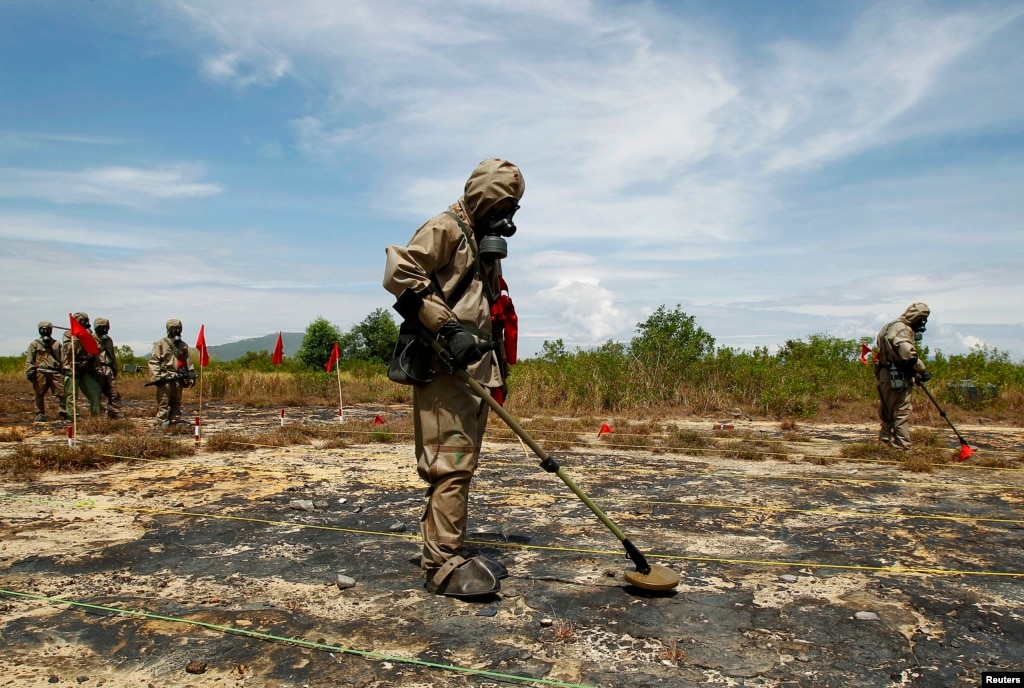
FILE - Soldiers detect Unexploded Ordnance (UXO) and defoliant Agent Orange in Vietnam's central Da Nang City.
TEXT SIZE 
Jim Stevenson
U.S. involvement in the Vietnam War was long and costly in many ways.  The conflict itself raged for more than two decades, but the consequences of military actions taken in Vietnam continue to this day.  One of the darkest legacies is the effect of a widely used defoliant meant to quickly clear dense forests and flush out enemy forces.  Known as Agent Orange, the chemical induced adverse health issues for both U.S. troops and Vietnamese on both sides of the war.

Peter Sills, an attorney who helped represent the Vietnam Veterans of America in a class action lawsuit regarding the use of Agent Orange, has written about it in a new book titled Toxic War. Speaking with VOA’s Jim Stevenson, Sills told of the many ways Agent Orange had a direct effect on people, and how it even evolved into a weapon.


SILLS:  The thing that surprised me the most, when the (U.S.) government found out people were scared of it (Agent Orange), they began spraying the Vietnamese people deliberately. Whether they knew they were poisoning them or not is a question I raise in my book. And there is evidence on both sides of that.

STEVENSON:  So what you are asserting is at the very least unintentional chemical warfare.

SILLS:  Yes, a chemical war. The U.S. government used chemicals that were not manufactured as weapons but they were used as weapons. That includes herbicides, riot control gasses. Napalm which is supposedly used to defoliate was modified to stick to human flesh. As we started to lose the war and become more desperate, we changed the tools we used to help in the war, we started to use them against people.

STEVENSON:  How were American veterans at that time being exposed in harmful ways?

SILLS:  When you start spraying towns and villages, there are American soldiers there too. That is part of it. The food that people ate became poisoned, and the water that people drank. There is another surprising thing: herbicides came in 50-gallon barrels. When they were emptied, they were not really empty. There were two or three gallons of herbicide left in the barrels. Soldiers used them for showers, for bar-b-ques (grills for cooking). Vietnamese used them to hold gasoline and wound up spraying dioxin all over Vietnam. The cities became defoliated even though they were never sprayed (from U.S. planes). They were sprayed by Vietnamese automobiles and motorcycles. No one could figure it out for a while. So people were exposed in surprising and unexpected ways.

STEVENSON:  How many U.S. veterans are we talking about looking for some sort of compensation because of exposure to Agent Orange?

SILLS:  Hundreds of thousands, possibly over a million. That is muddy unfortunately because there are so many people who are sick for reasons other than herbicide exposure. The symptoms of dioxin exposure, the poison in the herbicide, are not very different from what people get normally, heart attacks, diabetes, lung cancer, liver problems, neurological problems, things that people just get. So to determine whether they were actually exposed, it should be possible to do that. But the officially done science has not been able to do that.

18 February 2014

DOD Refused (Again) To Designate C-123s As Agent Orange Exposure Sites

Asked for the third time, DOD declined for the third time to recognize former Agent Orange spray aircraft as "Agent Orange Exposure Sites." While we are not aware of the political reasons which prevent this logical step, we understand the reluctance DOD has in anything likely to assist veterans in claiming Agent Orange exposure.

Usually DOD cites lack of medical information or some other dodge, but this time they simply and honestly said, "no."

In a touch of DOD humor, we were referred back to the VA, where both we and DOD already know how C-123 veterans' claims are treated.

13 February 2014

Institute of Medicine 2012 Report - Covered In-Country Issues Only!

Many point to the 2012 Institute of Medicine Agent Orange Report as somehow disagreeing with non-Vietnam herbicide exposure claims. Nothing could be farther from the truth! The VA assigns specific goals to the Committee ("Charge to the Committee") which restricts what is to be addressed. Thus, proof upon proof could be offered on various topics such as Blue Water Navy or C-123 exposures, and note will be made of the off-topic presentations but nothing done by the Committee nor commented upon!

08 February 2014

Our Pictorial History of Post-Vietnam Agent Orange Exposures

 1961-1971
C-123K medium assault transports modified to spray as UC-123K, dispersed Agent Orange throughout South Vietnam from although in later years spraying was gradually reduced. 1971 –aircraft returned to the US; spray tanks were removed, the airplanes then flown to their new units without any decontamination.

1972-1982
Wearing standard flight suits, C-123 fleet was then flown by Air National Guard and USAF Reserve squadrons (Massachusetts, Ohio, & Pennsylvania) as the Vietnam War ended. 1979 tests identified herbicide contamination. Crews assured all aircraft safe. 1982 – C-123s retired to desert “boneyard” at Davis-Monthan AFB, AZ.

1994-2009
1994 AF toxicologists reported C-123 “heavily contaminated” with dioxin. Full HAZMAT then ordered for all personnel in or near the toxic airplanes.
2001 – all C-123s were gathered into a special, high security quarantine area, reacting to base employee TCDD IG complaints.


June 2010 – on recommendation of the Office of Secretary of Defense Senior Consultant to several civilian and military officials, with concerns expressed that veterans already exposed might seek VA medical care, all C-123s destroyed by USAF as hazardous waste with special measures taken to insure the "below-the-radar" operation.
2011-2014: "VA will permit no C-123 Agent Orange exposure disability claims" 

06 February 2014

Yale Law Announces C-123 Agent Orange Claims Report

Yale Law School posted their release of the C-123 Exposure Legal Brief on their web site today, making it available to veterans nationwide. Many, many thanks to Yale for this scholarly presentation of our case. We were exposed to Agent Orange. We should be treated for Agent Orange illnesses.

Once again, but its never enough...thanks to Dean Wishnie and his team!

All C-123 vets should get this to whoever is representing your disability claim. If you are managing your own claim, my suggestion is to attach it to a VA-21-4138 with your note as to the importance of this document. Tell the VA simply that Yale Law completed a laborious investigation of the C-123 Agent Orange exposure situation, and concluded that we were exposed. Exposure is the only requirement that a veteran who is not a Vietnam veteran needs to prove. This document, your Form 5s or other proof of duty aboard former spray aircraft, and the other supporting documents you can download from this blog should present a convincing argument.

VA will oppose anyway, having already informed us they have a policy forbidding C-123 claims as per Post Deployment Health and regardless of any law or proofs to the contrary. Having your proofs of exposure, and this legal brief, will at least make the rating official think twice and perhaps risk resisting orders to deny your claim. And having this in your claim will certainly prove telling at the Board of Veterans Appeals.

03 February 2014

Our group needs help from a Colorado resident C-123 veteran! Please contact us!

Also, I could use some help here, especially from Ranch Hand vets. Please...no disagreement about consultants or the AF Study or anything...just whether or not folks who flew the Provider after Vietnam should be considered eligible for service connection for Agent Orange illnesses. They approach VA with a stack of evidence past any reasonable "as likely to as not" threshold, yet it may be felt scientifically questionable by some.

They have assurances from a wide range of legal experts, including several in the Congress, who say the law is clear regarding military herbicide exposures, and that under that law, using the scientists' evaluation of the exposure claims, the claims for service connection should be granted. 

Isn't the scope of the C-123 argument reasonable and fact-based? Doesn't a legal and scientific argument lean in favor of a veteran submitting significant persuasive unpaid, volunteered legal opinion and expert scientific evidence? Isn't there some point when Ranch Hand vets, who know the most and who have the most background in this whole mess can t say, "the case seems reasonably well-founded....past 50/50." 

We need more influential veterans to give us a hand in this rather than remain on the sidelines, watching VA build their wall, point-by-point, against anything we find to help our claims. We need more VA folks to help us understand where we can make our case more effectively, on legal, moral, scientific grounds.

Talking to VA people over the years, they themselves can't believe claims have been rejected on the basis of harmless TCDD. They can't believe the ATSDR findings were ordered ignored by C&P... ignored by VA because ATSDR isn't a military organization and JSRRC was ordered to evacuate only military archival documents, not expert scientific interpretations of those source documents. 

VA uses whatever means to dispute or ignore every truth.

Last week my new VA oncologist couldn't believe my prostate cancer claim was denied because my AF Form 5s, flight order and other evidence of flying Patches, evaluated by both the NIH and the ATSDR to have exposed me to enough TCDD to increase my risk of cancer 200-fold, was denied with VA explaining in the denial that TCDD is harmless. Speaking with an ethicist, she thought I was mistakenly summarizing the VA's actions redefining exposure. Another VA ethicist said, if true, this history sounds more criminal than ethical in its details. 

My first VA oncologist, a medical school professor, acknowledged TCDD and cancer researcher with significant peer-reviewed work establishing that Agent Orange exposed veterans have twice the rate of highly aggressive prostate cancers, asked me why his physician's opinion letter was disregarded on my claim. As were all the other physicians' findings, including senior medical officers of the US Public Health Service. He explained that the VA doesn't operate that way, and I must be mistaken.

This is why entries on this forum are usually crammed with hotlinks to source documents...we're not making any of this up!

01 February 2014

VA Insists VA Rule Does Not Apply To VA

"If a veteran did not serve in the Republic of Vietnam, but was exposed to an herbicide agent defined in 38 C.F.R. 3.307(a)(6) during active military service, has a disease on the list of diseases subject to presumptive service connection, VA will presume that the disease is due to the exposure to herbicides."
VA’s  Guide on Agent Orange Claims, Compensation and Pension Service,” carries this information, and VA repeats it on the Federal Register 8 May 2001 and Federal Register 31 August 2010.

VA, however, according to Post Deployment Health and as personally explained to me by the Director Compensation and Pension Services has decided to direct that Compensation and Pension never award service connection for Agent Orange exposures. This is because Post Deployment Health revised the standard definition of "exposure" to add "bioavailability" and, using their new definition, has continued their insistence that no C-123 veterans would receive service connection, actual fact-proven exposures or not.

This threatens all veterans concerned about every possible exposure...VA has redefined away exposures and their definition is now used to prevent exposure claims, even in the face of fact-proven exposure situations. With the new definition VA can pretend away every claim.

Thus, this VA rule does not apply to the VA, according to VA leadership.

Agent Orange Registry – Closed to C-123 Veterans

In 2013 VHA explained to me their policy which reversed the decision first reached in 2001
by the Secretary of Veterans Affairs, when the Secretary opened up the Agent Orange Registry to all veterans who consider themselves potentially exposed.

The Agent Orange Registry is fully detailed in VA Handbook 1302.01(Agent Orange Registry Program) dated 5 September 2006, except for the changes ordered by Post Deployment Health that relate to C-123 veterans.

The confusion arises because the veteran seeking an Agent Orange exam must, of course, believe he or she has been exposed. It seems the logic, by decision of Post Deployment Health, is that no C-123 veterans were ever exposed. That apparently is the reason for orders to VAMCs to deny C-123 veterans any such exams or health care. No possibility of exposure = no AO exam. Simple.

I hope this clears us the confusion we caused by reading the regulations and VA's web site, which don't include the VHA decision.

VA and Department of Defense Ignore DOD Instruction 6055.05

Why this article? Because it affects 2100 veterans' claims, and we provide hot links and quotes to make readers aware that there is backup for what we discuss. This article addresses the DOD Agent Orange Site List, which is run by DOD managers who recently refused to add specific contaminated C-123 tail numbers to their list.

It is the military's responsibility: DOD is to designate those present
or former Agent Orange facilities as "Agent Orange tests and storage locations, and the dates associated. The list is handed off to the VA which publishes their own web pages and supporting documentation.

VA doesn't generate the list...DOD does. There is nothing in law military procedures or VA regulations like VA 21-1A which permits VA to avoid considering fact-proven exposure claims from other locations than those specified. 


The DOD OPR for this is DCS/Logistics, Installations and Mission Support. It was asked 
by C-123 vets to add, in a retrospective manner, the destroyed former UC-123K Agent Orange spray aircraft as designated sites.

However, DOD resists designating any new site at all, but has worked with VA and JSRRC to add Blue Water Navy vessels from time to time.

The C-123 veterans provided the decades of test data showing the TCDD contamination, plus the various letters between the Air Staff and general officers by which the aircraft are referred to as "the Agent Orange airplanes." We wrote DOD's list managers a couple times and they kindly responded to our first letter but not sense. They wrote once, saying that we were fully understood. And flatly declined. And ignored our following letters providing them answers to the challenges they mentioned.

Helpfully (?), they referred us back to the VA for help. The VA which had earlier referred us to DOD. Which had first referred us to the VA. At some point in this decision-avoidance cycle, we gave up and wrote DOD's OPR, but ended up still strapped in, ejection seat as well as self-destruct mechanism armed, aboard military's go-ask-somebody-else decision avoidance aerospace vehicle, the famed Mark One A1 Merrygoround.


Our earlier request resulted in DOD saying the medical community (whose...VA?) had not been able establish the degree of harm caused by the C-123 dioxin contamination. DOD then said, based on that (not the confirming TCDD exposure tests,) her "assessment remains unchanged. We cannot designate these aircraft Agent Orange sites." Obviously the AF can designate them Agent Orange airplanes, which they've done for decades. In 2013, however,  DOD insists, even so, Defense cannot designate them "Agent Orange sites." Perhaps there is some sort of difference? Airplane? Site?


DOD certainly knows the history: VA asked DOD in 2006 to compile a list of CONUS exposure sites, and there was no mention of any qualifier as to a site having to have established any degree of medical harm or threat. None! And Defense must also know that our aircraft did nearly all the contamination work in Vietnam, and much of it here at home. 

Despite the expert opinions and AF evidence given, does DOD consider the toxin's vessel, our C-123, somehow less contaminated, less hazardous, than the fields the aircraft contaminated with its Agent Orange sprays?

Problems abound regarding the DOD AO list:
1. DOD resists designating exposure sites, especially abroad, due to obvious international relations complications.
2. VA raters routinely deny AO exposure claims, citing the absence of the location described by the veteran as not on the "approved" or "authorized" VA list of sites. What VA list? It is a DOD list. No requirement exists for any place to be on the list to acknowledge exposure by VA or AF, but places and ships named do help a veteran establish exposure – a site unnamed is certainly not to be taken as proof against exposure
3. DOD has been shown reams of its own military documentation generated over the decades as to C-123 Agent Orange storage sites, plus it has unrestricted access to the secret VA and AF C-123 documents and history as to the continued toxicity of the UC-123K fleet, and refused to add to their list. In fact, DOD senselessly referred the problem back to the VA for resolution...who refers the veterans back to the DOD...which refers the veterans back to the VA. Get the idea? See above.
4. There is no regulatory barrier to designating exposure sites with unknown potential for harm, the basis for DOD's refusal. Rather, the applicable DOD manual is DOD Instruction 6055.05 does two things important to C-123 veterans:
A. 6055.05 establishes DOD's definition of exposure, which contracts directly with the VA's own unique, policy-driven definition created to block C-123 claims
*DOD: The intensity, frequency, and length of time personnel are subjected to a hazard*VA: Exposure + contamination field + bioavailability.
1. See the difference? VA added bioavailability in their 2012 official redefinition of exposure. This is a redefinition with which other federal agencies, professional medical and scientific societies, industrial toxicologists and university medical schools and public health schools disagree. VA Post Deployment Health is pretty much against the world on that issue. VA leadership supports because more claims can be denied, regardless of legal or scientific basis, or condemnation by their peers in science and medicine.  
2. By the DOD definition of exposure, C-123 veterans were indeed exposed while on duty and subject to the effects of DOD Instruction 6055.05 and preceding publications. USAF tests identified the contaminated aircraft aboard which we served for ten years. Other federal agencies, such as ATSDR and NIEHS, confirm our exposures aboard the C-123, and by the DOD definition of being frequently placed over ten years in an aircraft "heavily contaminated with TCDD on all test surfaces" fulfills the definition perfectly.

B. Unfortunately for us, USAF failed the C-123 crews by ignoring the reporting provisions of 6055.05 and preceding regulations, both as for unit and individual reports. Tellingly, in later years the Deputy Surgeon General of the Air Force opted not to inform the TCDD-exposed C-123 aircrews "to prevent undue distress." 

I guess DOD's letter reporting difficulty in establishing just how much harm the TCDD caused it suggests the the Air Force not only that it is best not to tell us, but best to keep the C-123s off the DOD list. Perhaps authorities didn't read the copy I sent of the official finding by the CDC/Agency for Toxic Substances and Disease Registry. It was written by Deputy Director Dr. Tom Sinks, who in 2012 officially informed the VA and AF that :
1. C-123 crews underwent exposures 182 times the military screening value for TCDD exposure.
Does DOD set an even higher threshold to permit agreement that we've been even potentially harmed? Does it require 183? 184?
2. US Army screening values calculate to a 200-times greater risk of cancer for C-123 veterans.
Does DOD set an even higher threshold to permit agreement that we've been even potentially harmed. Does DOD require 201? 202?
I believe the Department of Defense would be concerned if the Secretary of Defense learned that office exposures where he works doubled his cancer risk...he'd likely seek different Pentagon accommodations. Why this profound disregard for the C-123 situation? Are we not veterans with a legitimate concern? 

Was the restatement of the ATSDR findings by the Director of the ATSDR (Dr. Christopher Portier) in March 2013 and then by the incoming Director, Rear Admiral R. Ikeda MD US Public Health Service, not adequate to satisfy?

Expert toxicologists informed the AF and VA repeatedly that our C-123 crews were subjected to 25 times the maximum TCDD exposure limits recognized by the CDC, State of New York and other agencies. That is not enough for DOD?

Why are the thresholds of proof of exposure set higher for
us...without even definitions as to how high VA leadership wants them set...than for other veterans claiming exposure benefits? Did we give somebody a bad ride back in the day, or not have hot coffee for all the passengers and we ticked off a future AF general or VA administrator?

Is the problem what it truly MUST be...leadership failure in the VA; folks who simply decided on their own that no C-123 claims will be permitted to receive service connection? Not on their watch!

Veterans' Files Destroyed in St Lewis – by Student Clerks

ST. LOUIS -- More than 1,800 personnel records for U.S. veterans were destroyed or misfiled by two student employees of the National Personnel Records Center in St. Louis County, federal criminal court documents show.
One of the student employees, Lonnie Halkmon, 28, was sentenced Thursday to two years of probation and ordered to perform 40 hours of community service. The other, Stanley Engram, 21, is scheduled to be sentenced Feb. 7. Both pleaded guilty to a misdemeanor charge of destruction of government records and faced probation to six months in prison under federal sentencing guidelines.

30 January 2014

CNN Report: Veterans Die Waiting For Medical Care (this is NEW news?)

From today's CNN website, which restates earlier coverage in other publications
(CNN) -- U.S. veterans are dying because of delays in diagnosis and treatment at VA hospitals.
At least 19 veterans have died because of delays in simple medical screenings like colonoscopies or endoscopies, at various VA hospitals or clinics, CNN has learned.
That's according to an internal document from the U.S. Department of Veterans Affairs, obtained exclusively by CNN, that deals with patients diagnosed with cancer in 2010 and 2011.
The veterans were part of 82 vets who have died or are dying or have suffered serious injuries as a result of delayed diagnosis or treatment for colonoscopies or endoscopies.
Barry Coates is one of the veterans who has suffered from a delay in care. Coates was having excruciating pain and rectal bleeding in 2011. For a year the Army veteran went to several VA clinics and hospitals in South Carolina, trying to get help. But the VA's diagnosis was hemorrhoids, and aside from simple pain medication he was told he might need a colonoscopy.

29 January 2014

"Agent Orange Linked to Increased Risk of Skin Cancer" – University of Texas Medical School


Agent Orange linked to increased risk of skin cancer


See also


Vietnam War veterans exposed to Agent Orange at higher risk for non-melanotic invasive skin cancer
A new report adds to past evidence that risk of non-melanotic invasive skin cancer (NMISC) is increased even four decades after Agent Orange exposure, with at least some exposed veterans having unusually aggressive non-melanoma skin cancers.
Agent Orange is the code name for an herbicide and jungle defoliant developed by the United States military during the Vietnam War. It has been linked to a wide range of cancers and other diseases, caused by the highly toxic dioxin contaminant TCDD.
As of 2009, there were 485,760 Vietnam veterans with documented Agent Orange exposure registered with the U.S. Department of Veterans Affairs, and many of these veterans reported significant health problems,
According to Dr. Mark W. Clemens, M.D, Assistant Professor of Plastic Surgery at The University of Texas MD Anderson Cancer Center,” TCDD is among the most carcinogenic compounds ever to undergo widespread use in the environment”
Dr. Clemens and colleagues set out to determine if prior exposure to TCDD was associated with an increased incidence of nonmelanotic invasive skin cancer.
The researchers reviewed the medical records of 100 consecutive male patients with Fitzpatrick skin types I through IV who enrolled in the Agent Orange registry at the Veterans Affairs Hospital of Washington, D.C., between August of 2009 and January of 2010.
The patients average age was 65.7 years (range, 56 to 80 years). TCDD exposure included living or working in contaminated areas (56 percent), actively spraying it (30 percent), or traveling in contaminated areas (14 percent).
Among the patients 51% had nonmelanotic invasive skin cancer, about twice as high as the rate expected in men of similar age group. The risk of skin cancer increased to 73% for veterans who actively sprayed Agent Orange. Exposed men with the lightest skin types and those with lighter eyes were also at higher risk.
Forty-three percent of the veterans had chloracne, and 26 percent had other malignancies, such as prostate (14 percent), colon (3 percent), or bladder cancer (2 percent).
Exposure by means of active spraying (73 percent versus 67 percent; p = 0.003) and presence of chloracne (81 percent versus 28 percent; p < 0.001) were associated with increased nonmelanotic invasive skin cancer incidence rates.
Exposure to Agent Orange and TCDD has been linked to a wide range of health problems, including many different cancers. However, its association with the basal cell carcinoma and squamous cell carcinoma—the two most common types of skin cancer—has been unclear.
Cases of "aggressive and diffuse" non-melanoma skin cancers in TCDD-exposed veterans were first reported in plastic surgery journals in the mid-1980s. Dr. Clemens and colleagues initiated their study after observing similar patients in their clinic over the last few years. The researchers emphasize that their study has some important limitations—including the lack of detailed information on TCDD exposure and the absence of a comparison group of Vietnam-era veterans not exposed to Agent Orange.
Nevertheless, the results strengthen the previously reported association between TCDD exposure and the development of NMISC, even many years after exposure. Certain groups appear to be at particularly high risk, including veterans actively involved in spraying Agent Orange, those with chloracne, and those with lighter skin types.

26 January 2014

VA Revises Their C-123 Agent Orange Web Page

We just noticed the revised C-123 page on VA's web site. While
its code shows a date of 31 December 2013, I've read the page a couple times this month and it was the old version.

Here, VA has strengthened their barriers against our claims by analyzing many of the expert opinions in our favor. 

Of course, no mention is made anywhere of challenges raised to this product of the VA's small Post Deployment Health Section...challenges from the CDC/Agency for Toxic Substances and Disease Registry, the NIH/National Institute for Environmental Health Sciences, the US Public Health Service and many others. Challenges which have labeled the VA's work "unscientific," and worse!

Of course, VA continues to ignore the simple fact that the 1991 Agent Orange Act, and Title 38, and several postings in the Federal Register only specify "exposure," so this page's attempt to minimize our exposure is irrelevant...we were exposed. 

VA...read the law. Read Yale's C-123 exposure brief. However, we still know that when faced with new evidence in our favor such as Yale's brief, VA's only response is – how to negate the favorable evidence. If they can't dispute it, they'll ignore it. Or redefine words just like they reinvented "exposure" to exclude C-123 veterans. 

If opinions are offered by experts, VA denies their expertise even if the experts are internationally recognized authorities, VA researchers or heads of US government agencies! As Post Deployment Health has already determined and already informed us and Compensation & Pension Service (despite Under Secretary Hickey's and Secretary Shinseki's mistaken written assurances to the contrary) VA will never approve a C-123 Agent Orange exposure claim. 

Regardless of any evidence, proof, testimony, research, opinions, whatever...officially VA has predetermined that all C-123 exposure claims will be denied, per Post Deployment Health. VA told the veterans. VA even told the US Army following a meeting with the veterans. It seems the only two people who don't know that VA has a blanket policy forbidding C-123 veterans' claims are Generals Hickey and Shinseki. 

I'm only a retired major, but I don't think generals use different words..."blanket policy" does seem to cover any situation like ours, where C-123 veterans' denials are predetermined and insisted upon regardless of evidence or law.

If they knew, I'm sure these highly esteemed leaders would correct the situation, especially after the Secretary formally informed the Senate that no such blanket policy exists.

25 January 2014

Blue Water Navy Vets Suggestion A Correction From C-123 Veterans

Gladly done, John

I once posted a comparison between the two Agent Orange-exposed groups, citing proofs each may have. My goal was to differentiate the two sets of evidence, not to separate us as veterans with a common goal. The point I'd hoped for was that the C-123 veterans need to stand apart, on the basis of our own eligibility because we'd never qualify under the set of qualifications the Blue Water Navy has as their pathway.

John is correct: the BWN veterans were originally covered by the VA, but a few years ago VA narrowed its definition of Vietnam veteran to the "boots on the ground" troops. This excluded BWN, except for the sailors already having a VA disability rating.

I appreciate John's note and his good wishes, and extend to the BWN our regards and hopes that both groups will prevail in this struggle with the VA.
Wes,
            I’d like to applaud you for your tenacity and the resulting well-written email on countering the discrimination the C-123 pilots are receiving from the VA. The facts are in your favor, and the reactions of the VA are embarrassing to any rational analysis. You lay the facts out well, with one exception.
            I’m aware that you feel there is no comparison between the problems of the C-123 pilots, who you believe have rock-solid evidence of exposure, and the Blue Water Navy veterans, who you believe are grasping at straws to search for a means of exposure.
            That’s OK…. We can all believe what we want. But since you are a very factual, non-speculative person regarding these issues of dioxin exposure, I feel you should stick to that mindset, even in your comments about the Blue Water Navy situation.
            When the Agent Orange Act of 1991 was written and passed, the only description contained in the Act itself addressed “a veteran who, during active military, naval, or air service, served in the Republic of Vietnam during the Vietnam era.” When the act was passed, it was forwarded to the Dept. of Veterans Affairs for them to develop the rules and procedures that would be followed to enforce this new law.
            THEY are the ones who came up with the description that “….“service in Vietnam” will be conceded if the records show that the veteran received the Vietnam Service Medal.” The VSM was awarded to anyone who was in the Theater of Combat, which the VA knew well included an outline 80 to 100 nautical miles offshore. In fact, since they were the ones who ‘put it in the regulations,’ that is why the Federal Circuit Court allowed them to change it – because it was their own regulation. They would not have been allowed to change Public Law 102, but they were allowed to change their own wording regarding who would receive benefits and who would not.
            So it is not factual to say that the Agent Orange Act of 1991 ever addressed the condition of Boots-on-Ground or Offshore Waters. That was all done by the VA itself. And it stayed written that way for 11 years.
            I’m sure you will see the important distinction here and will change your comments regarding this matter in all your statements and literature. Let’s just stick to the facts of the matter. I, for one, am still rooting for you.

            Regards,

                                -JR

24 January 2014

AF Decision Not to Inform Agent Orange-exposed Veterans May Violate DOD Instruction No: 6490.03

The decision by the Air Force not to inform veterans who'd flown the C-123 transports about our Agent Orange exposures may have violated an important formal instruction issued by the Department of Defense.

DOD Instruction Number 6490.03 states that:
"All exposures shall be reported that are immediately hazardous to life or health or that may significantly increase long-term health risks (e.g., cancer) through appropriate command channels."

The dioxin (the toxic component of Agent Orange) contamination was first confirmed in 1979 (Conway) and confirmed by testing the same airplane at the USAF Museum in 1974. Patches, Tail #362, was determined to be "heavily contaminated with dioxin on all test surfaces" and "a danger to public health."

Despite this, AF officials in the USAF Office of Environmental Law directed all relevant information "be kept in official channels only," and the veterans not informed. In 2013, the Assistant Surgeon General of the Air Force told the Senate this was "to prevent undue distress."

We see nothing in DOD Instruction Number 6490.03 about preventing servicemember or veterans' "distress." We can read between the lines, however, and see that the AF prefered to keep the whole mess under cover. Or, as officials at Davis-Monthan AFB said when the C-123s were being shredded as toxic waste in 2010, "below the media's radar." That's why the consultant from the Office of Secretary of Defense congratulated Hill AFB and Davis-Monthan AFB officials...the whole mess was kept as quiet as possible.

I'm sure the VA and USAF wouldn't want to cause undue distress by telling veterans that we now have a 180-fold increase in our cancer risk factors, according to the CDC/Agency for Toxic Substances and Disease Registery. 


I guess that's why VA rejected the CDC finding, as well as findings by all the other federal agencies stepping in to tell VA we'd been exposed!

Check it out...we're not making this stuff up. We don't have to! We provided the hotlinks above...any question, just drop us a note.

VA's Board of Veterans Appeals Cites Phony Post Deployment Health C-123 Study in Decisions Against Other Veterans

Not Vet! VA Docs & Nurses=SUPERB, but Administration=ZERO!
The VA's Post Deployment Health, part of the Office of Public Health in Veterans Health Administration, reviewed literature about C-123 and Agent Orange during 2011-2012. Selecting those reports best fitting their predetermined goal of denying any exposure possibilities, they then published an Internet page explaining away all possibilities of aircrew exposure. Again, this so-called "study" was done to prevent successful claims, and the report was written to make sure supporting evidence of such exposure was ignored. Now VA is using the phony study more broadly and against other veterans besides the C-123 crews.

Their shoddy, policy-driven work product was put together to save VA the estimated $250,000,000 (needed to care for exposed C-123 veterans' Agent Orange presumptive illnesses. It has been challenged strongly by non-VA scientists and physicians, with labels thrown at VA including "ludicrous, not defensible, lacks understanding of the scientific process, clearly does not understand toxicology, not a toxicologist, flawed" and concluding that the C-123 subjected us to "every likelihood of veterans' exposure."

VA knew their work was sub-standard and it received no peer-review, nor have VA leaders been able to defend it. What was important to VA was refusing care to Air Force veterans whom their Agent Orange consultant labeled "trash-haulers, freeloaders looking for a tax free dollar from a sympathetic congressman." 

With that attitude, perhaps that is why the consultant's November 2012 report the VA paid him for recommended against our claims. Although, he did save that there was no way to disprove our exposure, he seems to have felt it best to make sure VA hospitals turned us away.

The problem with it has now grown well past the VA's deleterious use against C-123 veterans – VA now provides their deception for judges in the Board of Veterans Appeals to use against other veterans' exposure complaints. 

While I am not familiar with details of these troops' claims or of any true merit they may have, I'm pained to read that the BVA now cites the phony C-123 study even against other veterans! On 15 November 2013, the BVA in Jackson, Mississippi, issued Citation Nr: 1337387:
"Of note, the Department of Veterans Affairs did addressed residual Agent Orange exposure concerns by post-Vietnam crews that later flew C-123 aircraft that had previously sprayed Agent Orange. VA's Office of Public Health is noted to have thoroughly reviewed all available scientific information regarding the exposure potential to residual amounts of herbicides on the C-123 aircraft surfaces. It was concluded that the potential exposure for the post-Vietnam crews that flew or maintained the aircraft was extremely low and therefore it was concluded that the risk of long-term health effects was minimal. (See www.publichealth.va.gov/exposures/agentorange.)  
Otherwise, other than his unsubstantiated allegations, there simply is no evidence that the Veteran was exposed to Agent Orange or other herbicides based on his contact with any military vehicle that may have once been used in Vietnam."
Amazing, unscientific, deceptive, and unethical! Using shoddy policy-driven deceptions wrapped up as Post Deployment Health "studies" to not only insure C-123 veterans are prevented from receiving VA hospital care, but also finding other purposes, other employment for this drivel. 

The only "thorough review" Office of Public Health completed was to separate the piles of scientific literature into the short pile...(no proof of exposure) from the big pile (proof of exposure), and then to shred the big pile. Now, the only pile left is VA crap published as their C-123 Internet pages. 

Particularly ignored by VA were opinions from the CDC/ATSDR, National Institute of Environmental Health Sciences, EPA and US Public Health Service which conformed the C-123 veterans' exposure! VA considers its scientific expertise in the Post Deployment Health Section, which is responsible for preventing veterans' claims, to exceed that of all the other federal agencies, universities, independent scientists and physicians...even VA physicians who have officially confirmed C-123 veterans Agent Orange exposure. Do you see now why no peer review was ever conducted? It wouldn't have been acceptable to science and medicine.

A few (we think, four) physicians and scientists in a small section of VA Office of Public Health...hell-bent on preventing C-123 exposure claims, bravely standing up to the opinions of the rest of American medicine and science (and even other VA physicians who disagree with them!!) 

Imagine: A little VA office called Post Deployment Health, hotly opposed by the CDC, EPA, NIH, US Public Health Service, professional societies, veterans organizations (VVA and American Legion and VFW) and a score of universities, all claiming those four folks in Post Deployment Health are wrong. 

But VA is responsible for enforcing the nation's laws...so VA decides how not to enforce them at its pleasure. VA pretends the Federal Register of 8 May 2001 and 31 August 2010 do not apply to them, or us. But does the Secretary know these many other federal agencies, with the statutory authority and the scientific expertise, oppose his little shop in Post Deployment Health?


Does the Secretary know that Compensation and Pension is ordering C-123 exposure claims denied, in defiance of the Secretary's assurances to the Senate that no such blanket policy exists? Can somebody please forward him another copy of the Washington Post from August 5?

The Secretary responded to Senator Burr's inquiry about C-123 veterans in his report of June 7, 2013. After keeping the Senator waiting for several months (that's how they keep each other "in their place" in DC...they stall for months before responding, then have a more junior person respond) the Secretary was handed a report to sign, written by some staffer who might have done a better job double-checking fact and figures! The C-123 veterans have noted the many problems with the letter, but here, note in particular the Secretary's erroneous assurances that there is no blanket policy against C-123 veterans. 

Than why has Post Deployment Health predetermined that VA will never concede our exposures, and told Compensation and Pension that none of us were ever exposed and that our claims must be denied? Can that not be called a blanket policy, when VAROs even deny claims with the standard language from DC, "Please tell the veteran, "Regulations do not permit..." 

Somebody in Congress from Mississippi should take note...your veterans in Jackson are being screwed! Just like the C-123 vets!