Showing posts with label c123. Show all posts

21 February 2014

Voice of America Reviews Agent Orange in Vietnam

News / USA

Q&A: The Story of Agent Orange
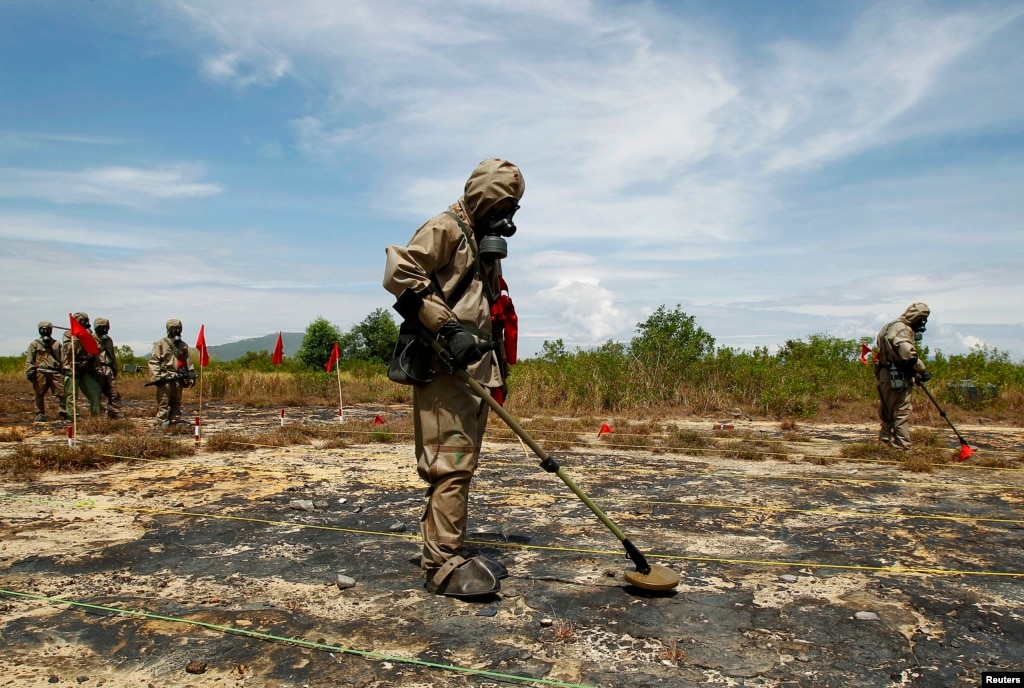
FILE - Soldiers detect Unexploded Ordnance (UXO) and defoliant Agent Orange in Vietnam's central Da Nang City.
TEXT SIZE 
Jim Stevenson
U.S. involvement in the Vietnam War was long and costly in many ways.  The conflict itself raged for more than two decades, but the consequences of military actions taken in Vietnam continue to this day.  One of the darkest legacies is the effect of a widely used defoliant meant to quickly clear dense forests and flush out enemy forces.  Known as Agent Orange, the chemical induced adverse health issues for both U.S. troops and Vietnamese on both sides of the war.

Peter Sills, an attorney who helped represent the Vietnam Veterans of America in a class action lawsuit regarding the use of Agent Orange, has written about it in a new book titled Toxic War. Speaking with VOA’s Jim Stevenson, Sills told of the many ways Agent Orange had a direct effect on people, and how it even evolved into a weapon.


SILLS:  The thing that surprised me the most, when the (U.S.) government found out people were scared of it (Agent Orange), they began spraying the Vietnamese people deliberately. Whether they knew they were poisoning them or not is a question I raise in my book. And there is evidence on both sides of that.

STEVENSON:  So what you are asserting is at the very least unintentional chemical warfare.

SILLS:  Yes, a chemical war. The U.S. government used chemicals that were not manufactured as weapons but they were used as weapons. That includes herbicides, riot control gasses. Napalm which is supposedly used to defoliate was modified to stick to human flesh. As we started to lose the war and become more desperate, we changed the tools we used to help in the war, we started to use them against people.

STEVENSON:  How were American veterans at that time being exposed in harmful ways?

SILLS:  When you start spraying towns and villages, there are American soldiers there too. That is part of it. The food that people ate became poisoned, and the water that people drank. There is another surprising thing: herbicides came in 50-gallon barrels. When they were emptied, they were not really empty. There were two or three gallons of herbicide left in the barrels. Soldiers used them for showers, for bar-b-ques (grills for cooking). Vietnamese used them to hold gasoline and wound up spraying dioxin all over Vietnam. The cities became defoliated even though they were never sprayed (from U.S. planes). They were sprayed by Vietnamese automobiles and motorcycles. No one could figure it out for a while. So people were exposed in surprising and unexpected ways.

STEVENSON:  How many U.S. veterans are we talking about looking for some sort of compensation because of exposure to Agent Orange?

SILLS:  Hundreds of thousands, possibly over a million. That is muddy unfortunately because there are so many people who are sick for reasons other than herbicide exposure. The symptoms of dioxin exposure, the poison in the herbicide, are not very different from what people get normally, heart attacks, diabetes, lung cancer, liver problems, neurological problems, things that people just get. So to determine whether they were actually exposed, it should be possible to do that. But the officially done science has not been able to do that.

05 September 2013

Lesson Learned – Don't Tweak the VA's Nose!

Last Friday the VA's eBenefits site showed my disability claims had been resolved, and today I learned just how. The VA denied all fifteen claimed! Thus it seems the VA has firmed up their resistance to C-123 claims following the single claim permitted on 31 July 2013 when the Manchester VA Regional Office approved Paul Bailey's claim.

Very surprising was VA's failure to address each of the proofs I submitted as well as dismissing all my "lay" evidence. They just said "no."

I'm already 100% for other issues so the disappointment I feel is only in the painful realization that they meant it..."No C-123 claims will be permitted to be approved," as per VA's Post-Deployment Health

04 September 2013

Linda Schwartz Named as VA Asst Secretary Policy & Planning

Connecticut Gov. Malloy, Lt. Gov. Wyman Statements on
Appointment of Commissioner Linda Schwartz to
the U.S. Department of Veterans' Affairs
(note: retired AF flight nurse Linda Schwartz, who previously flew with the 74th Aeromedical Evacuation Squadron, has left her post as Connecticut's Commissioner for Veterans Affairs to assume duties as Assistant Secretary for VA Policy and Planning. She has been a firm advocate for C-123 exposure issues.)

Governor Dannel P. Malloy and Lieutenant Governor Nancy Wyman applauded Connecticut Department of Veterans Affairs Commissioner Linda Schwartz on her nomination to the U.S. Department of Veterans Affairs. If confirmed, Commissioner Schwartz will serve as the new Assistant Secretary of Veterans Affairs for Policy and Planning, a key administration position.

“I applaud President Obama on his nomination,” said Governor Malloy. “For more than ten years, Commissioner Schwartz has been a strong and important voice for veterans in Connecticut, and she is an excellent choice to serve veterans on a national level. Her appointment is also a great loss for
Connecticut. The Commissioner’s integrity and her work on behalf of Connecticut’s veterans and women veterans, and on the Governor’s Veterans Cabinet has a critical impact on improving how the state delivers programs and services to our veterans and military service members. She has greatly improved the lives of our military men and women.”

“I have known and worked with Commissioner Schwartz for a very long time and have witnessed her commitment and passion for countless veteran’s issues first- hand,” Lt. Governor Wyman said. “Connecticut has been fortunate to have her service and her patriotism, and I am confident that in her new role she will bring that same unmatched sense of caring to our nation’s veterans.”

Commissioner Linda Spoonster Schwartz, a retired U.S. Air Force nurse who served from 1968-1986, has led the Connecticut Department of Veterans Affairs since 2003. She is a member of the Governor’s Veterans Cabinet, an in initiative launched by Governor Malloy in 2012 to improve delivery of services to veterans, and played a key role in the creation of veterans.ct.gov, a one-stop tool that links veterans and their families to other state and federal agencies offering services in areas such as employment and job training, health care and education.

Commissioner Schwartz is also the President of the Board of the Connecticut State Veterans Memorial, the state’s first memorial honoring all Connecticut veterans. The Veterans Memorial is being constructed in Minuteman Park across from the William A. O’Neill State Armory in Hartford and will be a site for official observances, activities, and ceremonies that honor veterans. 


Message from VVA National President John Rowan
I am proud to announce that one of our own, Dr. Linda Spoonster Schwartz, has been nominated for the position of Assistant Secretary of Veterans Affairs for Policy and Planning at the VA. Linda has been a tireless fighter on behalf of veterans and a long- standing member of VVA. We look forward to her having a large impact on VA operations. Congratulations Linda! 

02 September 2013

Springfield Republican: C-123 Vet Wins VA Agent Orange Claim


Westover veteran exposed to Agent Orange  wins appeal for benefits by Jeanette Deforge
After more than two years of battling for benefits to help Westover Air Reserve flight crews exposed to Agent Orange, one veteran has scored a major victory. 

Retired Lt. Col. Paul Bailey, who is suffering from incurable prostate cancer which has spread to his pelvis and ribs, recently learned a federal review panel overturned a denial of assistance and granted him Agent Orange-related disability benefits. 


Bailey, 67, and other veterans who served on C-123 Provider planes from 1972 through 1982 at Westover Air Reserve Base, in Chicopee, learned three decades later the planes they flew and worked on were previously used to spray Agent Orange in Vietnam and were contaminated with the residue. 


Many are now falling ill from prostate cancer, diabetes and heart disease, which are all conditions known to be caused by dioxin, the toxic chemical in Agent Orange. 


“I absolutely believe it was exposure to Agent Orange that caused it,” Bailey said. “There is nothing else that I can think of that would have made it spread so fast. It (prostate cancer) is very slow growing, it is not prevalent in my family and it spread really fast.” 


Bailey, who retired from the Air Force after 37 years and now lives in New Hampshire, earned medical and retirement benefits. The disability benefits are tax free and will go to his wife upon his death. 


Until this award, the U.S. Department of Veterans Affairs repeatedly rejected applications for benefits based on post-war service on the C-123s. While acknowledging the planes were contaminated, officials contend the toxic residue would not penetrate human skin. 


Veterans received another blow when an Air Force study released in April 2012 said crews were unlikely to have fallen ill from being exposed to dioxin. It also cited a lack of data to make a definite determination.

Officials for the Office of Veterans Affairs have repeatedly said the toxic element of Agent Orange cannot be inhaled or absorbed and would be difficult to ingest so they continue to deny requests for claims. They have not changed their position in the past few weeks because of Bailey's award.

“The VA’s Office of Public Health thoroughly reviewed all available scientific information regarding the exposure potential. We concluded that the potential of exposure for the post-Vietnam crews that flew or maintained these planes was extremely low and therefore, the risk of long-term health effects is minimal,” its website reads. 


Bailey’s ruling is a victory but it is not precedent-setting, said Archer B. Battista, of Belchertown, a semi-retired lawyer for the firm of Lyon and Fitzpatrick who served at Westover starting in 1974 and retired as a colonel from the Air Force Reserve in 2001. 


“It doesn’t seen like a slam dunk that says I flew on the planes so I’m in the pool for eligibility,” he said. “I think the decision in Paul’s case will be persuasive but not necessarily determinative.” 


Battista, a Vietnam War Veteran, was diagnosed with prostate cancer in 2009 when he was 62. He receives benefits because of his exposure to dioxin during the war, but has joined with other Westover veterans to fight for those who are not eligible for the same assistance. 


Ideally veterans would like to see a ruling similar to the congressional Agent Orange Act of 1991 which grants medical and disability benefits to anyone who can show they stepped foot in Vietnam between 1965 and 1970 and are ill with one of 15 different diseases presumed to be caused by Agent Orange, he said. 


“I think the importance of it is finally they have gotten the VA to recognize that it has to give credence to this scientific evidence,” he said. 


For two years, Veterans Affairs officials have acted like a “bureaucratic monolith with its fingers in its ears” ignoring test data showing the planes were contaminated and statements from multiple scientific experts saying the veterans were likely to have been exposed to dioxin from the residue, he said. 


“Sooner or later the righteous side prevails. You look at the evidence and you see the agency backing farther and farther into the corner,” he said. 


To apply for benefits, military personnel submit claims to their regional veterans department. If rejected, they can appeal to the federal Board of Veterans Appeals. 


Bailey instead requested an administrative review of the denial, which was done in New Hampshire. He submitted 56 different pieces of evidence, many of them gathered by a friend, retired Air Force Major Wesley Carter. 


“After reviewing and weighting the evidence of record, the Decision Review Officer has determined that the preponderance of the evidence suggests you were exposed to herbicide onboard U.S. Air Force C-123K aircrafts. Reasonable doubt in regards to the exposure to certain herbicide, to include Agent Orange, as the result of occupational hazards onboard C-123K aircrafts is resolved in your favor,” said the decision from the Department of Veterans Affairs Manchester (NH) Regional Office. 


Several veterans have won claims from the Board of Veterans Appeals, but it can take between two and five years, which is far too long for a veteran who is gravely ill or needs medical care, said Carter, now an Oregon resident, who served as an air medical technician and flight instructor with Westover’s 74th Aeromedical Evacuation Squadron for 20 years and flew in the C-123s from 1974 to 1980.

In comparison, Bailey’s appeal took a matter of months.


Carter, who has heart problems, a spinal cord injury and prostate cancer, discovered that he and his fellow crew members were exposed to Agent Orange when he started research to find out why he was so ill. 


He found a wealth of documents through the Freedom of Information Act, including tests from 1994 and 1996 showing at least 11 of the 16 planes at Westover tested positive for dioxin. One was labeled “highly-contaminated” a decade after it was retired. 


Documents included 15 years of memos, safety reports and complaints from private companies and military workers. In 2000, the government canceled sales of the toxic planes and in 2010, the remaining 18 were shredded and smelted to satisfy Environmental Protection Agency regulations. 
Citing the information, Carter said he thought it would be easy for those who fell ill with one of the conditions linked to Agent Orange to receive benefits.

But then the decisions began arriving: Denied for Carter. Denied for Bailey. Denied for multiple others.


“I didn’t think there would be illogical push back contrary to the law, contrary to the face of evidence,” Carter said. “Naively, I thought two years ago, ‘Here is some proof.’” 


In the time since Carter discovered the contamination, he created and constantly updates a blog on the subject, made YouTube videos and lobbied elected officials.


“How much proof does a veteran need to provide to the VA,” he said. “This should not be our job. I’m supposed to be focusing on my family and my health.” 

U.S. Sen. Richard Burr of North Carolina, the ranking Republican on the Veterans’ Affairs Committee, is one of the few advocating for the group. 


In April, he wrote to Eric K. Shinseki, secretary for Veterans Affairs, asking the C-123 veterans’ claims receive a fair evaluation. 


To bolster their case, he outlined the test results and opinions of scientists and how they conflict with the position of Veterans Affairs officials. 


“These and opinions from other experts suggest, at a minimum, that there is no clear-cut answer to the question of whether the veterans who flew on these planes and maintained them were putting their own health at risk. With that in mind, I ask you to ensure that and disability claims from the veterans who operated these C-123s will not be pre-judged as lacking but, rather, will be considered based on the facts of each particular case,” Burr wrote. 


For John Harris, who served in the military for 33 years before retiring as a lieutenant colonel in 1997, the political pressure brought by Carter may be the final element needed to reverse what seems like blanket denials for C-123 veterans. 


Harris, of Mashpee, said he has been trying to contact congressmen as well but most of his calls and emails have been ignored. 

“It seems they are just denying everything and letting the guys die and the claims go away,” Harris said. 


The fight for the C-123 veterans is especially frustrating since Harris and Battista estimate there are fewer than 2,000 eligible to make claims. 


They and others have been continuing to focus on a second part of the puzzle, which is trying to contact Reservists and National Guard members who served on the planes and don’t know they were exposed to Agent Orange. 


The attempt is especially difficult when trying to reach those who served at Rickenbacker Air National Guard Base in Ohio and in the Pittsburgh Air National Guard, which also flew some of the former Agent Orange spray planes. Air Force officials have refused to share records requested for that purpose, Harris said. 


“We had a lot of people who stayed for a year or two. I put ads in the Air Force magazine and the Reserve Officer magazine asking people to contact me and nobody, nobody contacted me,” Harris said. 


Those who know they were exposed can share the information with their doctors and take preventative measures to stay healthy and get early diagnosis if they do fall ill, Battista said.


“How do we notify people who are not yet sick?” he asked.

PTSD and Coming Home

Just an FYI re: VA Mental Health and Counseling:

Back from Operation Desert Storm and seriously injured, with multiple operations not helping things too much, I asked for some advice (counseling) at the Asheville VA Medical Center.

I reached out. I didn't get it. Total extent of their response: I was invited to attend a couple afternoon VA-sponsored picnic on the Medical Center's back lawn complex, with all other veterans being the local Navy Construction Battalion sailors who'd also been overseas. I don't know if any VA staff were present...all that happened was munching on refreshments, a cup of Coke, shaking hands of other vets and that was all. A picnic.

From what I recall, this was the limit of VA outreach in the areas of mental health...shouldn't call it outreach because one had to ask to find out about it. Not really outreach, as there seemed to be nothing except a few "just ask for help" posters had been taped up on walls and elevators. And no follow-up on that request nor subsequent requests for medication.

I was told that, having my back surgery two weeks earlier at Bethesda Naval Hospital, the soonest the VA ortho clinic could see me for care would be about six months. I was prescribed narcotics to last me until then, and I pulled out the wire staples myself

Over the next twenty years, the sole mental health interest in me by the VA has been the occasional question about depression, with heads nodding at whatever my response (sometimes quite intense) and on to the next question on whatever unrelated health form was being completed.

Suggestion: The VA might more effectively prevent veterans' post-deployment suicides by some form of actually doing something. Perhaps, offer their smorgasbord of resources rather than passively wait to be asked or be forced to intervene because of inappropriate veteran behaviors. Practitioners should read the VA's own publications, including their pivotal article identifying PTST among patients who've experienced three or more surgeries. I've had twelve since Desert Storm and more coming.

Every veteran should be approached by a social worker for an informal background assessment and an offer of resources. Every combat veteran and every severely ill or severely disabled veteran must receive social worker intervention, requested or not, as so few veterans grasp the full range of their own issues, and so few grasp the range of VA resources which might help address their needs.

Clearly, PTST should be assumed among various groups of veterans and eliminated by individual evaluation, rather than waiting for problems to come to a boil.

September 12 2013 Update: Not much changed except the posters urging vets to reach out have been updated to "It Takes a Warrior" theme. Even calls to the VA's suicide prevention hotline are problems, and the system's chat feature drops conversations repeatedly. Really, now VA: hanging up the call mid-conversation on a vet who is reaching out for help at 0300 isn't much help!

Do you think it might be better just to switch to calming elevator music??

About Face..
by Smedley D. Butler, Major General, United States Marine Corps, 1936 Two time recipient of the Congressional Medal Honor (regarding WWI soldiers but applicable to all of our wars)
“Boys with a normal viewpoint were taken from the fields and offices and factories and classrooms and put into the ranks. There they were remolded; they were made over; they were made to ‘about face’, to regard murder as the order of the day. They were put shoulder to shoulder, and through mass psychology, they were entirely changed. We used them for a couple of years, and trained them to think nothing at all of killing or of being killed. Then suddenly we discharged them and told them to make another, “about face.” This time they had to do their own readjusting without mass psychology, without officers aid and advice, without nation-wide propaganda. We didn’t need them any more. So we scattered them about without any speeches or parades. Many too many, of these fine young boys are eventually destroyed, mentally, because they could not make the final, “about face," alone.

31 August 2013

A Lighter Spirit, Saturday Morning After Feeding the Grandkids

What not to ask a veteran...


Always my favorite - beats "I'm with Stupid –>"

The Big Wait - Claim Decided But WHAT Was Decision?

I'm away from home but noticed on eBenefits my two claims has been decided and notification sent.

So...I won't know the results for quite some time. I expect, however, that all issues have been denied because eBenefits' letter request section hasn't changed in any way...it should have if my percentages had been upgraded as requested.

So, the "Big Brown Envelope" will be waiting for me at home in a few weeks. Once I return I'll finally know, after waiting 27 months, if VA has continued their compassionate response to C-123 veterans's claims as per Paul Bailey's award exactly one month ago, or if they continue to oppose our arguments for service connection.

I am a bit surprised on the claim I filed this year, as I haven't even had C&P exams for several of those claimed disabilities...yet it has also been decided.

Let's hope it is good news, as friends like Dick Matti, Mrs. Bill Schindler, Mrs. Aaron Olmsted and others are waiting with even greater concern than I have!

VA Needs Better Oversight of Veterans Service Organizations' Service Officers

Florida's Sen. Nelson calls for improvements in VA benefit application process By  , 
Published: 
The process veterans face when applying for benefits is complex and often takes years. So, many veterans turn to representatives, accredited by the Department of Veterans Affairs, to help them navigate the system.
But the GAO report, requested by Nelson (R-FL) and other senators last year, was released today and shows that the VA does not do a good enough job vetting those representing the veterans, relying on “limited, self-reported information to determine whether applicants have a criminal history or their character could be called into question.”
As a result, the GAO report found “some representatives had histories of bankruptcies or liens, and a number of other issues that would raise concern.”
Nelson and fellow Sens. Patty Murray (D-WA), Richard Burr (R-NC) and Bernie Sanders (I-VT) asked the GAO – the nonpartisan research arm of Congress - to examine the VA’s Aid & Attendance program after the U.S. Senate Special Committee on Aging held a hearing last year that focused on veterans who needed help getting pension benefits. Nelson earlier this year became chairman of that committee.
Hundreds of thousands of veterans rely on representatives to help them with their claims, according to the GAO.
“However, current program implementation and requirements do not ensure that veterans and their families are protected against potential abuses,” according to the report, “or that VA has the ability to identify and address situations where representatives are not acting in the best interests of clients.”
Nelson is asking that the VA provide a “clear definition of the requirement that an accredited individual have ‘good moral character.’ ”
The VA should also create a way for complaints to be lodged against representatives, supported by written policies ensuring “an appropriate series of actions are taken to respond to, monitor, and follow-up on complaints.”
VA officials did not respond to a request for comment about Nelson’s letter to Shinseki.
In responding to the GAO, VA officials agreed that while it needs more staffing and technology resources to deal with the issue, any increases must come under its existing budget. The VA also “concurred in principle” to “strengthening initial and continuing” requirements that claimants have qualified representation, according to the report.
The VA told the GAO that “it is in the best interest” of veteran service organizations, like the Veterans of Foreign Wars, AMVETS and other groups,”to ensure their representatives are competent and qualified.” However, the VA said it will request and review training programs for about 10 percent of recognized organizations each year.
Leo Dougherty, an accredited representative from Tampa, said that the VA increasing its oversight is not adequate.
“I applaud Senator Nelson and those other elected officials in Congress for conducting oversight of the VA,” said Dougherty. “However, I’m not sure taking the Department of Veterans Affairs to task on this particular issue is the correct way to go. While the VA can discipline accredited representatives by warning, suspension of accreditation, or termination of accreditation they really don’t have much authority in the way of prosecution.”
Another problem, said Dougherty, is that most veterans don’t know how to file a complaint if they have one.
“The VA’s Office of General Counsel can take no action against an accredited representative without first knowing that a breach of ethics or legal responsibility has occurred, and most veterans would not know how to contact OGC to submit an allegation,” said Dougherty. “There is a process in place for this but it is not generally known and therefore not acted upon by OGC.”