The Physical Evaluation Board (PEB), nonetheless, concluded that medically retired veterans did not suffer from combat-related injuries, based on a PEB policy that burn pits are not “instrumentalities of war” except when being used to burn things like combat, simulated combat, Agent Orange exposure, spent ammunition, ordinance, or military vehicles. The PEB’s policy was contrary to the Army’s policy for administering Combat-Related Special Compensation, under which burn pits are treated as “instrumentalities of war.”
17 March 2026
Burn Pits Designed as “Instrumentalities of War” for Medical Retirement Combat-Related Findings
The Physical Evaluation Board (PEB), nonetheless, concluded that medically retired veterans did not suffer from combat-related injuries, based on a PEB policy that burn pits are not “instrumentalities of war” except when being used to burn things like combat, simulated combat, Agent Orange exposure, spent ammunition, ordinance, or military vehicles. The PEB’s policy was contrary to the Army’s policy for administering Combat-Related Special Compensation, under which burn pits are treated as “instrumentalities of war.”
01 March 2026
Disabled Veterans: A New 2026 Savings Program with tax-free investment growth: The Achieving a Better Life Experience (ABLE) account
GREAT NEW IRS TAX BENEFIT FOR DISABLED VETERANS. An Achieving a Better Life Experience (ABLE) account is a tax-advantaged savings tool for individuals (including disabled veterans who qualify) with disabilities, allowing them to save $20,000 each year without losing federal benefits like SSI, Medicaid, or VA disability! Authorized by the 2014 ABLE Act, these accounts vary somewhat by state, but they generally enable tax-free growth and withdrawals for "qualified disability expenses" such as housing, education, and transportation. Effective January 1, 2026, eligibility expands to those whose disability began before age 46, allowing tax-free growth and withdrawals for housing, healthcare, and education.
Previously, the disability had to begin by age 26, and that left most veterans unable to apply because so many of us became disabled later in life. Fortunately for us, the government moved that qualifying age up to 46 or earlier. For example, I was medically retired at age 45 following the Gulf War, but now am eligible for an ABLE account. There is a veteran-specific web page to learn more. An ABLE account seems ideal for those of us who don't itemize deductions...consult a tax professional wiser than me! An ABLE account is funded with after-tax income, but can also accept gifts and unearned income investment, unlike IRAs which are for earned income only.
Key Details for ABLE Accounts:
Eligibility: Must be a U.S. citizen/US state resident with a qualifying disability (SSA criteria) that began before age 46. 100% VA service-connected disability does not automatically apply, as VA and SSA disability standards are different. The issue is based on inability to work, although some employment is allowed. Checking qualifications online at the Able National Resource Center is an important next step. Each state also has its own info page, and vets can get specific info.
Benefits: Funds in the account are generally not counted against means-tested benefits (like VA, Medicaid/SSI) up to certain limits.
Tax Advantages: Contributions may be deductible from state income tax (they are in Colorado and most states), and earnings grow tax-free. ABLE accounts allow qualified disabled veterans to save up to $20,000 annually (2025/2026) without jeopardizing means-tested benefits like Medicaid or VA disability or pension, provided their disability occurred before age 46 (as of Jan 2026). Funds grow tax-free and can be used for qualified disability expenses, including housing, transportation, and healthcare. Property taxes and mortgage payment are typically included in the "housing" category.
Key Details for Disabled Veterans' ABLE Accounts
Eligibility Expansion: As of January 1, 2026, the age of onset for the disability increased from 26 to 46, making millions more, including many veterans, eligible.
Protection of Benefits: ABLE accounts allow for savings that do not count against the individual resource limit for SSI or other means-tested programs, such as the VA non-service-connected pension.
Definition of Disability: You must meet the Social Security Administration's (SSA) definition of "marked and severe" functional limitations, or have a signed physician's certification. You do not need to be receiving Social Security disability benefits to qualify, Additionally, if you were on SSDI but "aged-out" at 65, that's considered qualifying.
Qualified Expenses (QDEs): Funds can be used tax-free for a wide range of expenses, including education, housing, transportation, healthcare, prevention of homelessness, and employment training.
Contribution Limits: In 2026, the annual contribution limit is $20,000 which may increase annually. The current maximum in an account is limited to $100,000.
Account Setup: Veterans can open an account in any state that accepts out-of-state residents, with many offering online enrollment.
Eligibility:
Eligible for your state's ABLE account
US citizen and state resident
New accounts must be opened by June 30, 2026.
The account must be in good order to receive funds.
Funds can be dispersed the following month from when the account was opened.
26 October 2025
VA Claims for Peripheral Neuropathy – CLAIMS ARE NOT RESTRICTED TO ONE YEAR AFTER AGENT ORANGE EXPOSURE!
I've had so many conversations with veterans complaining that VA refuses their disability claims for delayed onset peripheral neuropathy. Theylling me that VA insists peripheral neuropathy (PN) is only covered if diagnosed within a year of Agent Orange exposure.
WRONG. But also just partly right: VA does have a presumptive disability for early onset-peripheral neuropathy diagnosed within a year of exposure. PN can also be claimed as a secondary disability from diabetes, and diabetes is a presumptive illness and that claim easily established. Very few veterans had early PN diagnosis because it most often develops over years.
But in no way does having PN diagnosed later in life prohibit PN disability claims based on what VA terms "direct service connection."
Put simply, direct service connection means a little more work convincing VA that, more likely than not, your peripheral neuropathy developed as a result of Agent Orange exposure regardless of the disease onset. You do this with a physician's nexus letter, which hopefully cites some of the many medical articles showing PN onset years and even decades after leaving military service.
Here's one such article, and it mentions PN developing 25-30 years after exposure:
de la Monte SM, Goel A. Agent Orange Reviewed: Potential Role in Peripheral Neuropathy and Neurodegeneration. Journal of Military Veterans Health. 2022 Apr;30(2):17-26. PMID: 36785586; PMCID: PMC9920643.
If needed, here's a helpful guide for submitting direct service connection and secondary condition service connection claims.
02 October 2025
Great News for Retirees Qualified for Combat Related Special Compensation
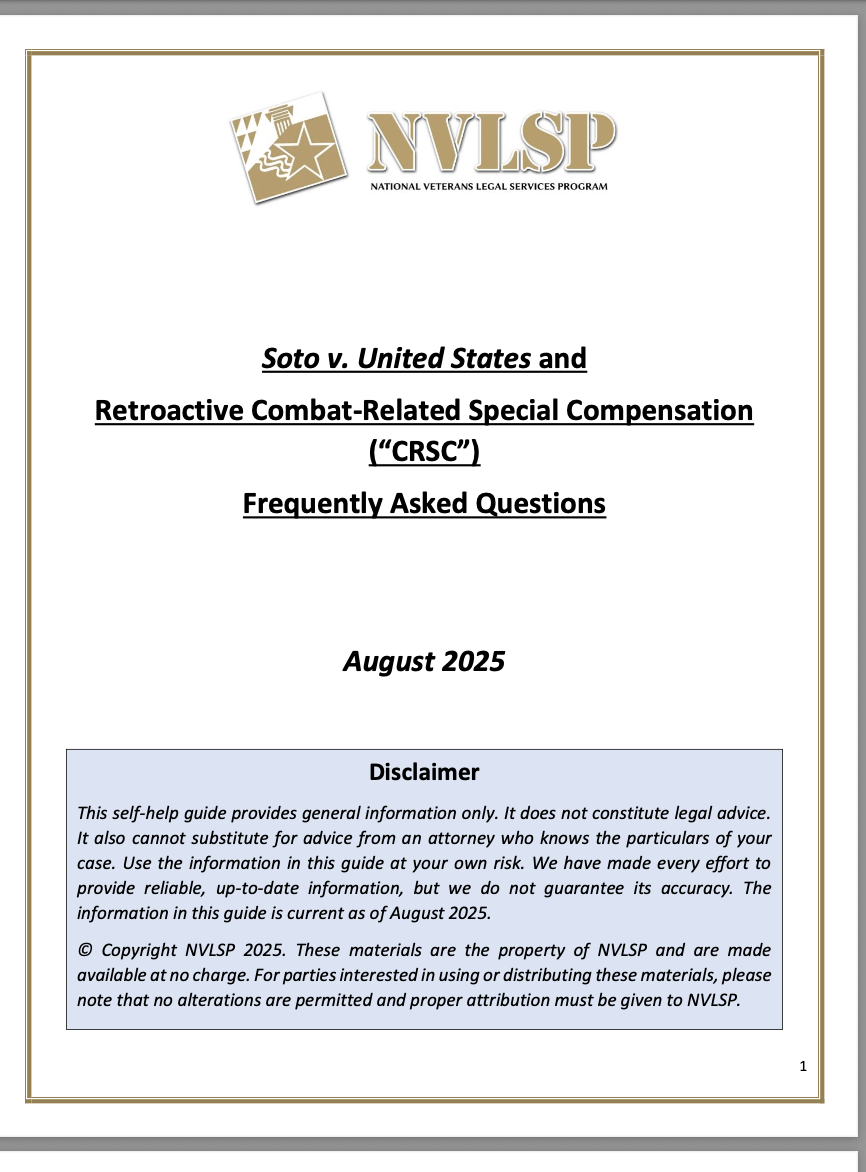
NVLSP Issues FAQ for Veterans on Retroactive Combat-Related Special Compensation (CRSC) under Supreme Court Unanimous Ruling on Soto v. United States
On June 12, 2025, the U.S. Supreme Court ruled unanimously in favor of a class of over 9000 disabled Army, Navy, Marine Corps, Air Force, and Coast Guard veterans who were wrongfully limited to six-years of retroactive combat-related special compensation (CRSC). The Supreme Court unanimously held that there is no six-year cap on retroactive CRSC payments.
On August 25, 2025, NVLSP published a Frequently Asked Questions (FAQ) guide regarding the Soto case. These questions include:
- Which Veterans will Benefit?
Veterans who (1) have been granted CRSC benefits, (2) qualified for retroactive CRSC benefits for a period longer than six years from the date they filed for CRSC, and (3) whose retroactive benefits were limited to only six years from the date of their initial application.
- How do I know if I am a member of the Soto class?
In 2021, DOD sent notices to approximately 9,000 individuals who were identified as belonging to the Sotoclass at that time.For veterans who were retired, obtained service connection, or received a CRSC decision after the 2021 notice to class members, there has not been any class notice. A detailed review of files would be required to determine whether a veteran is a class member.
- Will retroactive benefits be the same as current CRSC benefits?
Probably not. CRSC rates are based on VA compensation rates and there has been a cost-of-living adjustment most years. Rates paid in 2025 are different than rates paid, for example, 10 years ago.
- What is being done to implement Soto?
Counsel for the military has stated in a court filing in mid-August 2025: “The Department of Defense (DoD) is in the process of drafting a directive to the military branches and the Defense Finance and Accounting Service (DFAS) with guidance for implementing the decision in Soto both retroactively to individuals who have had the Barring Act applied to their Combat Related Special Compensation (CRSC) claims and prospectively with respect to future CRSC claims."
About The National Veterans Legal Services Program (NVLSP)
The National Veterans Legal Services Program (NVLSP) is an independent, nonprofit veterans service organization that has served active duty military personnel and veterans since 1981. NVLSP strives to ensure that our nation honors its commitment to its 18 million veterans and active duty personnel by ensuring they have the benefits they have earned through their service to our country. NVLSP has represented veterans in lawsuits that compelled enforcement of the law where the VA or other military services denied benefits to veterans in violation of the law. NVLSP’s success in these lawsuits has resulted in more than $5.6 billion dollars being awarded in disability, death and medical benefits to hundreds of thousands of veterans and their survivors. www.nvlsp.org.
Next Veteran Claim Packet: Avascular Necrosis
In my own situation, I associated Agent Orange exposure as the probable cause of two "new" hips (and a third because of infections), but it can also result from fractures, radiation, long-term steroid medication, alcohol abuse, parachuting, and joint dislocations. Suggestions most WELCOME!
28 September 2025
Newest Claims Project: Peripheral Neuropathy
I've drafted a sample VA disability claim for peripheral neuropathy as SECONDARY to diabetes. Vietnam War and C-123 veterans are presumed exposed to Agent Orange and already get service connection for diabetes if diagnosed. The effort here will be to illustrate how a veteran can get service connection by using diabetes type 2 (and other causes) and then peripheral neuropathy as a secondary issue.
Many vets have complained that their peripheral neuropathy claims long after Vietnam are denied due to VA's one year for symptoms requirement – this effort is an alternate approach using peripheral neuropathy as secondary to another illness or injury already recognized by VA as service connected. It’s for anyone, not just Agent Orange folks. Many other ailments are associated with peripheral neuropathy and if you have PN, you'd be wise to investigate.
25 September 2025
Pentagon Cancer Study Aids Aircrew & Maintainers' VA Claims
About YOU as a veteran, and perhaps also you as a veteran with cancers a Pentagon study identified as somehow related to aviation. We’re addressing active duty as well as Reserve Component servicemembers, and veterans of all services.
A 2024 Pentagon study identified several cancers as being significantly greater among aircrews and aviation ground support than in a similar non-flying population: What’s greater? 87% melanoma, thyroid cancer 39%, and breast cancer and prostate cancer both 16% greater. The study is attached for your review.
We’re veterans of the 74th Aeromedical Evacuation Squadron, Westover ARB, MA. Our history includes over a decade flying that infamous former Agent Orange spray airplanes, the C-123 Provider. Our planes remained contaminated with dioxin. It took many years of fighting until in 2015 VA finally conceded our exposures. Our veterans (plus dozens of other bases and units) are now presumed by VA as having been exposed and our claims for the various Agent Orange ailments are finally being honored. So much so, in fact, that over $80 million in medical care, compensation and survivor Agent Orange benefits have been won for C-123 veterans.
VA has typically denied Reserve Component exposure claims (except ours) insisting Reservists weren’t on full time active duty when exposed: no active duty = no benefits. They also insisted active duty veterans experiencing these cancers only many years after service weren’t injured with military exposures and their claims were also denied.
The Pentagon study is often our solution. It established that something associated with aviation is causing significantly greater risk of cancers, with worrisome percentages cited above. Now Reservists can claim an exposure injury and have the study (and their physician’s letter citing the study) as strong supporting proof. An exposure injury makes a Reservist a veteran per VA regulations. The same with active duty – if you flew, the study gives a link between flying/maintaining and the cancers. Being a Department of Defense report, the VA finds it damn hard to dispute, particularly because they contributed to it!
CLICK TO DOWNLOAD: Claims packets for flight crews and aviation ground support veterans: Melanoma, thyroid cancer, breast cancer and prostate cancer. All four combined in one file to simplify distribution. Each has an intro, the VA Form 526EZ to initiate a claim, the cancer-specific VA veterans benefit questionnaire" for a physical exam, and a VA statement explaining about the Pentagon study's importance to aviation-related disability claims.
23 September 2025
19 September 2025
08 September 2025
C-123 Aircraft Agent Orange Exposure –disability medical care and compensation
Our C-123 Agent Orange effort began at Westover in 2010 and has now impacted over 30 other Active Duty and Reserve Units, and thousands of veterans! Thus far, veterans and their families have received over $80 million in medical care, disability compensation, and survivor benefits.
If you had regular contact with C-123 aircraft while serving as an active-duty service member or Reservist, or are the survivor of such a veteran, you may be eligible for VA disability or other compensation. Call the VA today!
Active-duty units
Reserve units
LTCOL Joan Hartnett, former commander 74th Aeromedical Evacuation Squadron, has passed on.
Joan T. Hartnett died on Thursday May 29th at the Sunrise of Lynnfield following a lengthy illness. She'd recently celebrated her 93rd birthday.
Joan was born in Revere on May 13, 1932, to her parents John and Mary Hartnett. She, along with her sister Mary, were raised and educated in Revere. She was an alumna of Revere High School, Class of 1950. Joan then pursued her passion of becoming a nurse by enrolling in the Cheslea Memorial Hospital Nursing School.
After she completed her studies, she began her career at Albert Einstein Medical Center. From there, she went on to work for Malden Hospital and Boston City Hospital. In the meantime, she enlisted in the United States Air Force Reserves in 1967 and became a Chief Flight Nurse. Her career in the military spanned 25 years. During her time in the Air Force, Joan traveled all over the country and the world.
She was honorably discharged and retired as Lieutenant Colonel in 1992. Joan returned home too and continued her work as a nurse in Boston City Hospital. Joan loved being a nurse and did her job with the fullest measure of excellence.
She was also very devoted to her family, especially her sister Mary. In later years, Joan happily shared her time in Revere, Maine and Florida. Joan was a very humble woman, who was devoted to her country, family and her passion of being a nurse.
She is the beloved daughter of the late John T. Hartnett and Mary I. (Turner) Hartnett. The loving sister of the late Mary Cassani and her husband John A. Cassani. Also lovingly survived by many cousins, both living and deceased. In lieu of flowers donations may be made in Joan’s memory to the Mass General Brigham / Mass General development Office,
As one of her Medical Service Corps officers, I count it as wonderful memories the many times Joanie gave out with a frightening "CARTER COOL YOUR JETS!" admonition.
07 September 2025
Pentagon Study To Help Flight Crew and Aviation Ground Support Veterans' Cancer Claims
About YOU as a veteran, and perhaps also you as a veteran with cancers the Pentagon has identified as somehow related to aviation. We’re addressing active duty as well as Reserve Component servicemembers.
A 2024 Pentagon study identified several cancers as being significantly higher among aircrews and aviation ground support than in a similar non-flying population: What’s greater? 87% melanoma, thyroid cancer 37%, and breast cancer and prostate cancer both 16% greater. The study is attached for your review.
We’re veterans of the 74th Aeromedical Evacuation Squadron, Westover ARB, MA. Our history includes flying the infamous former Agent Orange spray airplanes, the C-123 Provider. Our planes remained contaminated with dioxin. It took many years of fighting until in 2015 VA finally conceded our exposures. Our veterans (plus many other bases and units- see attached lists)) are now presumed by VA as having been exposed and our claims for the various Agent Orange ailments are finally being honored. So much so, in fact, that over $80 million in medical care, compensation and survivor Agent Orange benefits have been won for C-123 veterans.
VA has typically denied Reserve Component exposure claims (except ours) insisting Reservists weren’t on active duty when exposed: no active duty = no benefits. They also insisted active duty veterans experiencing these cancers only many years after service weren’t injured with exposures and their claims were also denied.
The Pentagon study is our solution. It established that something associated with aviation is causing significantly greater risk of cancers, with worrisome percentages cited above. Now Reservists can claim an exposure injury and have the study (and their physician’s letter citing the study) as strong supporting proof. An exposure injury makes a Reservist a veteran per VA regulations. The same with active duty – if you flew, the study gives a link between flying/maintaining and the cancers. Being a Department of Defense report, the VA finds it damn hard to dispute, particularly because they contributed to it!
Here is information on the Pentagon study.
Here's the Vietnam Veterans of American excellent claims guide, although it focus on Agent Orange issues rather than aviation-related illnesses.
Peaceful passing of Colonel Mary Coyle, USAF NC, Retired
A sad flurry of emails among former members of the 74th Aeromedical Evacuation Squadron, Westover AFB, MA. We're learning of the deaths of USAF Colonel Mary Coyle and her husband, U.S. Marine Corps Colonel Edward Coyle.
Col. Mary Coyle and her beloved husband, long time residents of Milton, MA passed away peacefully on 10 July and 30 July, respectively.
Mary was born in Boston and was an RN at Carney Hospital. A devout Catholic she lived her life faith as she volunteered with the homeless and other charitable activities.
Col Coyle was a Flight Nurse Examiner and later the Commander, 74th Aeronautical Evacuation Squadron, Westover AFB, MA. She was a dedicated officer and a kind, skilled nurse. She trained and mentored many, many, young Flight Nurses and Medical Technicians (and Medical Service Corps officers!) and carefully prepared them for their combat medical roles.
Col. Coyle’s husband Ed was born in Dighton, MA. He was a U.S.Marine Corps Colonel who served with distinction. He was the recipient of the Purple Heart for injuries suffered in Viet Nam.
Mary was the model of an officer, a gentlewoman and a nurse. Also, a model of a commander I was blessed to know. Unnecessary details aside, she spent a few lunch hours with me down in the Boston MBTA, talking about careers and she quite literally changed several decades of my life for the better after that.
God bless her, her husband Ed, and those who with me mourn now her loss.
29 May 2024
Tinnitus: A Frequent Disability of C-123 Veterans. Should You File a Claim?
Yes. Absolutely submit a VA disability claim!
"It's a fact aircrews know well. Service members who work in and around aircraft are more likely to suffer hearing deficits!" (VA publication)
Aircrew duty in a C-123, C-130 and other military aircraft frequently causes (or worsens) hearing loss and/or ringing in the ears (tinnitus.) Hearing loss is the most common disability claimed by veterans and it is serious. Hearing loss and tinnitus is usually permanent, cumulative, and worsens with aging well past the years of your military service.
When a veteran submits a claim, the VA arranges a hearing test (a "Compensation and Pension Exam.") Then, if the problem meets VA standards, the vet is granted a disability rating, typically ten percent. In 2024 that's about $171 per month, tax-free, for the rest of your life. They also provide medical care with free audiology exams and high-end hearing aids if required. The compensation dates from the day VA receives a claim, so it makes sense to apply immediately if you believe you have the problem. Claims can be submitted on-line or by mail. Major veterans organizations such as DAV, VFW and the American Legion offer free claims assistance, as do all state veterans service departments and most counties.
It is important to know hearing problems can also lead to other, even more serious disabilities. The VA considers these "secondary conditions." Linking these secondary conditions to the initial hearing loss disability can lead to an increased overall disability rating, vital VA medical care for those problems and greater monthly compensation.
Example: My college roommate had an incident during Army Reserve basic training in 1969 which affected his hearing and was documented. However, that documentation was misfiled into his dental records. Over the years following military service the hearing loss increased greatly and he was convinced (he resisted years of my urging!) to submit a VA disability claim. He was initially granted a 30% disability rating due to the severity of the hearing problem but his secondary condition of depression related to hearing loss lead to a 100% total disability rating. He initially received a check for around $32,000 and qualified for full federal and state veterans benefits, something Reservists and National Guard personnel don't usually qualify for without active duty service.
This was a significant financial benefit, much needed in his situation. I referred him to Katrina Eagle, an experienced veterans attorney who discovered the "lost" Army documentation for the original 1969 hearing injury, and she convinced the VA to make this veteran's 100% disability rating retroactive - to 1969! The final check for that backdated VA compensation was well over $100,000.
That was certainly an unusual situation, but secondary conditions are important for the VA to address, both in medical care and compensation. Let's look at hearing injury secondary conditions:
Secondary Conditions Related to Aviation Tinnitus or Hearing Loss:
Migraine Headache Conditions Secondary to Tinnitus or Hearing Loss: (continued below)
09 February 2024
BULLETIN: VA to ease benefits rules for exposures to Agent Orange in the US
VA eases rules for exposures to Agent Orange in the US
Thousands of veterans exposed to Agent Orange while serving in the United States will for the first time be eligible for fast-track disability benefits under plans unveiled by the Department of Veterans Affairs on Friday. As readers of this blog are aware (and as the new rules reiterate,) C-123 veterans are already considered presumptively exposed to Agent Orange and eligible for full veterans' benefits thereby. This coverage dates from June 2015.
The move represents another major expansion of toxic exposure benefits for veterans, this time for individuals suffering from illnesses dating back to the Vietnam War era. The changes follow mandates included in the Promise to Address Comprehensive Toxics Act — better known as the PACT Act — passed by Congress in August 2022.Over the last two years, a combination of administration moves and new legislation opened access to disability benefits for millions of veterans who incurred injuries from burn pit smoke, radiation contamination and other military toxic exposure events.
In a statement, VA Secretary Denis McDonough said the proposed moves “would make it easier for veterans exposed to herbicides who served outside Vietnam to access the benefits they so rightly deserve.
“Our goal is to provide every veteran of every era with the VA health care and benefits they deserve, and this is another step in the right direction,” McDonough said.
Rules outlining the change were filed in the Federal Register on Friday, and will still take several months before going into effect. The new proposal would give presumptive benefits status to veterans who served in “locations where herbicides were tested, used, or stored outside of Vietnam.”
That includes military locations in 12 states — Alabama, Arkansas, Florida, Georgia, Indiana, Maryland, Mississippi, Montana, New York, Tennessee, Texas and Utah — where Agent Orange was present in the 1940s, 1950s, 1960s and 1970s. A full list of the specific states and times is available on the VA website.
The rule would also cover troops stationed at Canadian Forces Base Gagetown in New Brunswick, Canada, in June 1966 and June 1967; individuals stationed in Kumbla, India, in 1945 and 1946; and expanded timelines for troops who served in Cambodia, the Johnston Atoll, Guam, American Samoa, Korea, Laos, and Thailand during the 1960s and 1970s.
A full list of these foreign locations is also available on VA websites.
Troops who served in Vietnam between January 1962 and May 1975 — either on the ground or in waterways around the country — already qualify for presumptive benefits status by the department because of Agent Orange exposure.
The toxic defoliant has been linked to a host of cancers and heart illnesses. Presumptive status means that individuals who develop certain illnesses believed caused by the chemicals do not have to document specific instances where they were exposed, but instead only provide service records showing they were in the area (or the C-123 unit) to be presumed contaminated.
As a result, advocates have pushed for broader use of presumptive status for troops who served around toxic chemicals while in the military but may not have been able to document every instance of exposure because of records lost over the years.
More information on Agent Orange presumptive benefits is available on the VA website.