Showing posts with label ACES. Show all posts

02 October 2025

Great News for Retirees Qualified for Combat Related Special Compensation

NVLSP Issues FAQ for Veterans on Retroactive Combat-Related Special Compensation (CRSC) under Supreme Court Unanimous Ruling on Soto v. United States
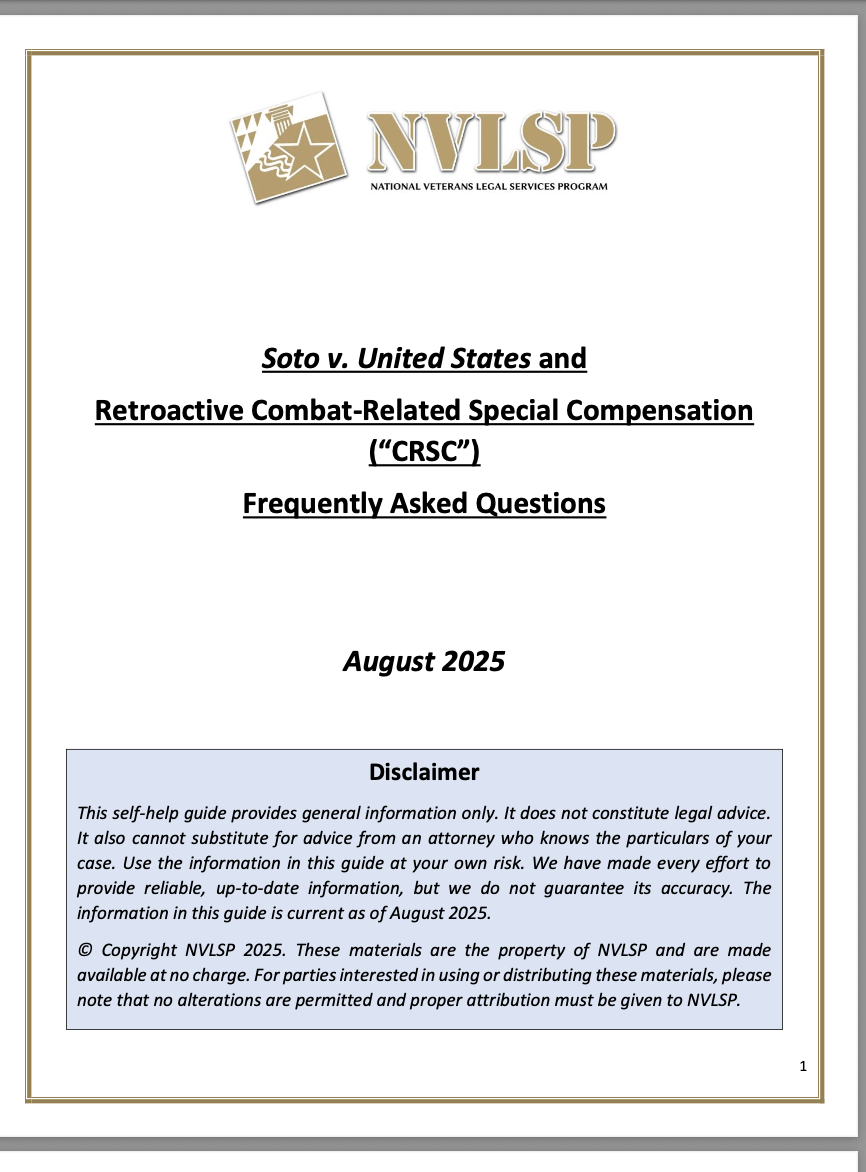
On June 12, 2025, the U.S. Supreme Court ruled unanimously in favor of a class of over 9000 disabled Army, Navy, Marine Corps, Air Force, and Coast Guard veterans who were wrongfully limited to six-years of retroactive combat-related special compensation (CRSC). The Supreme Court unanimously held that there is no six-year cap on retroactive CRSC payments.

On August 25, 2025, NVLSP published a Frequently Asked Questions (FAQ) guide regarding the Soto case. These questions include:


  • Which Veterans will Benefit?

Veterans who (1) have been granted CRSC benefits, (2) qualified for retroactive CRSC benefits for a period longer than six years from the date they filed for CRSC, and (3) whose retroactive benefits were limited to only six years from the date of their initial application.

  • How do I know if I am a member of the Soto class?

In 2021, DOD sent notices to approximately 9,000 individuals who were identified as belonging to the Sotoclass at that time.For veterans who were retired, obtained service connection, or received a CRSC decision after the 2021 notice to class members, there has not been any class notice. A detailed review of files would be required to determine whether a veteran is a class member. 

  • Will retroactive benefits be the same as current CRSC benefits?

Probably not. CRSC rates are based on VA compensation rates and there has been a cost-of-living adjustment most years. Rates paid in 2025 are different than rates paid, for example, 10 years ago.

  • What is being done to implement Soto?

Counsel for the military has stated in a court filing in mid-August 2025: “The Department of Defense (DoD) is in the process of drafting a directive to the military branches and the Defense Finance and Accounting Service (DFAS) with guidance for implementing the decision in Soto both retroactively to individuals who have had the Barring Act applied to their Combat Related Special Compensation (CRSC) claims and prospectively with respect to future CRSC claims."

About The National Veterans Legal Services Program (NVLSP)
The National Veterans Legal Services Program (NVLSP) is an independent, nonprofit veterans service organization that has served active duty military personnel and veterans since 1981. NVLSP strives to ensure that our nation honors its commitment to its 18 million veterans and active duty personnel by ensuring they have the benefits they have earned through their service to our country. NVLSP has represented veterans in lawsuits that compelled enforcement of the law where the VA or other military services denied benefits to veterans in violation of the law. NVLSP’s success in these lawsuits has resulted in more than $5.6 billion dollars being awarded in disability, death and medical benefits to hundreds of thousands of veterans and their survivors. www.nvlsp.org.

28 September 2025

Newest Claims Project: Peripheral Neuropathy

 I've drafted a sample VA disability claim for peripheral neuropathy as SECONDARY to diabetes. Vietnam War and C-123 veterans are presumed exposed to Agent Orange and already get service connection for diabetes if diagnosed. The effort here will be to illustrate how a veteran can get service connection by using diabetes type 2 (and other causes) and then peripheral neuropathy as a secondary issue.

Many vets have complained that their peripheral neuropathy claims long after Vietnam are denied due to VA's one year for symptoms requirement – this effort is an alternate approach using peripheral neuropathy as secondary to another illness or injury already recognized by VA as service connected. It’s for anyone, not just Agent Orange folks. Many other ailments are associated with peripheral neuropathy and if you have PN, you'd be wise to investigate.


25 September 2025

Pentagon Cancer Study Aids Aircrew & Maintainers' VA Claims

So...What's This All About?
About YOU as a veteran, and perhaps also you as a veteran with cancers a Pentagon study identified as somehow related to aviation. We’re addressing active duty as well as Reserve Component servicemembers, and veterans of all services.

A 2024 Pentagon study identified several cancers as being significantly greater among aircrews and aviation ground support than in a similar non-flying population: What’s greater? 87% melanoma, thyroid cancer 39%, and breast cancer and prostate cancer both 16% greater. The study is attached for your review.

We’re veterans of the 74th Aeromedical Evacuation Squadron, Westover ARB, MA. Our history includes over a decade flying that infamous former Agent Orange spray airplanes, the C-123 Provider. Our planes remained contaminated with dioxin. It took many years of fighting until in 2015 VA finally conceded our exposures. Our veterans (plus dozens of other bases and units) are now presumed by VA as having been exposed and our claims for the various Agent Orange ailments are finally being honored. So much so, in fact, that over $80 million in medical care, compensation and survivor Agent Orange benefits have been won for C-123 veterans.

However, Agent Orange is now pretty much in the “rear view mirror” for most veterans. Our concern shifts to you and other exposure injuries if you were in some way associated with military aviation and now suffer one of these cancers. We want to emphasize the importance of the Pentagon study and its value to a VA claim – and the great value to your physician who we hope will cite the study as persuasive in a nexus opinion supporting your VA claim for what VA terms "direct service connection."

The study can help support claims from aircrews or aviation ground support for cancers not already associated with VA-recognized exposure situations. It can also support claims from veterans regardless of whether or not they deployed to VA-recognized exposure situations.

VA has typically denied Reserve Component exposure claims (except ours) insisting Reservists weren’t on full time active duty when exposed: no active duty = no benefits. They also insisted active duty veterans experiencing these cancers only many years after service weren’t injured with military exposures and their claims were also denied.

The Pentagon study is often our solution. It established that something associated with aviation is causing significantly greater risk of cancers, with worrisome percentages cited above. Now Reservists can claim an exposure injury and have the study (and their physician’s letter citing the study) as strong supporting proof. An exposure injury makes a Reservist a veteran per VA regulations. The same with active duty – if you flew, the study gives a link between flying/maintaining and the cancers. Being a Department of Defense report, the VA finds it damn hard to dispute, particularly because they contributed to it!

There are four claim packets in our Pentagon report. For each named cancer, we’ve writing a brief introduction, attached a VA Form 526EZ disability claim form, the VA physical exam form for each specific cancer, and a VA Form 21-10210 statement of support. The 21-10210 explains to the VA claims agent why the Pentagon report constitutes powerful evidence supporting your claim. In fact, other veterans have already won claims and appeals by citing the report – it works! Share it with your VSO!

Here are individual claims packets, smaller and easier to download:


Good luck with your claim and let us know how you did.

Wes Carter, 74AES, C-123 Veterans Association.  
rustysilverwings@gmail.com
c123kcancer.blogspot.com

CLICK TO DOWNLOAD: Claims packets for flight crews and aviation ground support veterans: Melanoma, thyroid cancer, breast cancer and prostate cancer. All four combined in one file to simplify distribution. Each has an intro, the VA Form 526EZ to initiate a claim, the cancer-specific VA veterans benefit questionnaire" for a physical exam, and a VA statement explaining about the Pentagon study's importance to aviation-related disability claims.

Here is information on the Pentagon study.

07 September 2025

Pentagon Study To Help Flight Crew and Aviation Ground Support Veterans' Cancer Claims

So, what’s this all about?

About YOU as a veteran, and perhaps also you as a veteran with cancers the Pentagon has identified as somehow related to aviation. We’re addressing active duty as well as Reserve Component servicemembers.

A 2024 Pentagon study identified several cancers as being significantly higher among aircrews and aviation ground support than in a similar non-flying population: What’s greater? 87% melanoma, thyroid cancer 37%, and breast cancer and prostate cancer both 16% greater. The study is attached for your review.

We’re veterans of the 74th Aeromedical Evacuation Squadron, Westover ARB, MA. Our history includes flying the infamous former Agent Orange spray airplanes, the C-123 Provider. Our planes remained contaminated with dioxin. It took many years of fighting until in 2015 VA finally conceded our exposures. Our veterans (plus many other bases and units- see attached lists)) are now presumed by VA as having been exposed and our claims for the various Agent Orange ailments are finally being honored. So much so, in fact, that over $80 million in medical care, compensation and survivor Agent Orange benefits have been won for C-123 veterans.

However, Agent Orange is now pretty much in the “rear view mirror.” Our concern shifts to you if you were in some way associated with military aviation and now suffer one of these cancers. We want to help you understand the importance of the Pentagon study and its value to a VA claim – and the great value to your physician who we hope will cite the study as persuasive in a nexus opinion supporting your VA claim for what VA terms "direct service connection."

VA has typically denied Reserve Component exposure claims (except ours) insisting Reservists weren’t on active duty when exposed: no active duty = no benefits. They also insisted active duty veterans experiencing these cancers only many years after service weren’t injured with exposures and their claims were also denied.

The Pentagon study is our solution. It established that something associated with aviation is causing significantly greater risk of cancers, with worrisome percentages cited above. Now Reservists can claim an exposure injury and have the study (and their physician’s letter citing the study) as strong supporting proof. An exposure injury makes a Reservist a veteran per VA regulations. The same with active duty – if you flew, the study gives a link between flying/maintaining and the cancers. Being a Department of Defense report, the VA finds it damn hard to dispute, particularly because they contributed to it!

There are four claim packets in our Pentagon report. For each named cancer, we’ve writing a brief introduction, discussed the VA Form 526EZ disability claim form, the VA physical exam form for each specific cancer, and a VA Form 21-10210 statement of support. The 21-10210 explains to the VA claims agent why the Pentagon report constitutes powerful evidence supporting your claim. In fact, other veterans have already won claims and appeals by citing the report – it works! Share it with your VSO!

Here are individual claims packets:
Good luck with your claim and let us know how you did.

Wes Carter, 74AES, C-123 Veterans Association.  

CLICK TO DOWNLOAD: Claims packets for flight crews and aviation ground support veterans: Melanoma, thyroid cancer, breast cancer and prostate cancer. All four are in one file to simplify distribution. Each has an intro, info about VA Form 526EZ to initiate a claim, a cancer-specific VA veterans benefit questionnaire" for a physical exam, and a VA statement form with an explanation about the Pentagon study's importance to aviation-related disability claims.

Here is information on the Pentagon study.

Here's the Vietnam Veterans of American excellent claims guide, although it focus on Agent Orange issues rather than aviation-related illnesses.